When you first see that positive symbol on your pregnancy test, there’s no way of knowing whether you’re expecting one baby or multiples. It’s one of the many exciting yet slightly nerve-wracking aspects of pregnancy. What we do know is that the odds of conceiving twins have risen sharply over the past few decades. Reports from the National Center for Health Statistics (NCHS) found that in 1980, the twin birth rate was 18.1 per 1,000 live births. By 2020, that figure had climbed to 31.1 – an almost 72% increase over four decades.

Experts point to several contributing factors: a rise in fertility treatments, higher rates of obesity, and the growing trend of delaying pregnancy until later in life. Age, in particular, plays a central role.
Do Chances of Twins Increase With Age?
Globally, twins account for roughly 2% to 4% of all births, but that baseline shifts considerably depending on maternal age. CDC data show that women aged 30 to 39 are approximately twice as likely to conceive non-identical twins compared to women under 20. By the time a woman reaches her late 30s, her odds of a spontaneous twin pregnancy climb to around 1 in 60 – compared to closer to 1 in 100 for women in their early 20s. After 40, that figure rises further still, with some estimates placing the rate as high as 1 in 30 among women who conceive naturally.
There are two types of twins: identical (monozygotic), in which a single fertilized egg splits, and fraternal (dizygotic), in which two separate eggs are each fertilized. Age primarily increases the rate of dizygotic twins through a process called hyperovulation. As women get older, the body produces more follicle-stimulating hormone (FSH), which can stimulate more than one follicle to release an egg in a single cycle. FSH levels typically begin rising noticeably around age 35 – the same threshold that defines advanced maternal age – which is why the chances of having twins after 35 increase so meaningfully compared to earlier decades. If both eggs are fertilized, the result is a fraternal twin pregnancy.
Age has no meaningful effect on identical twin rates, which remain relatively stable at around 3 to 4 per 1,000 births regardless of maternal age. The age-related spike is almost entirely driven by fraternal twins, making maternal age one of the strongest natural predictors of a multiple pregnancy.
Twin Probability by Age Bracket
Understanding your approximate odds at each life stage can help you plan and prepare. Here is how twin probability generally shifts across age groups:
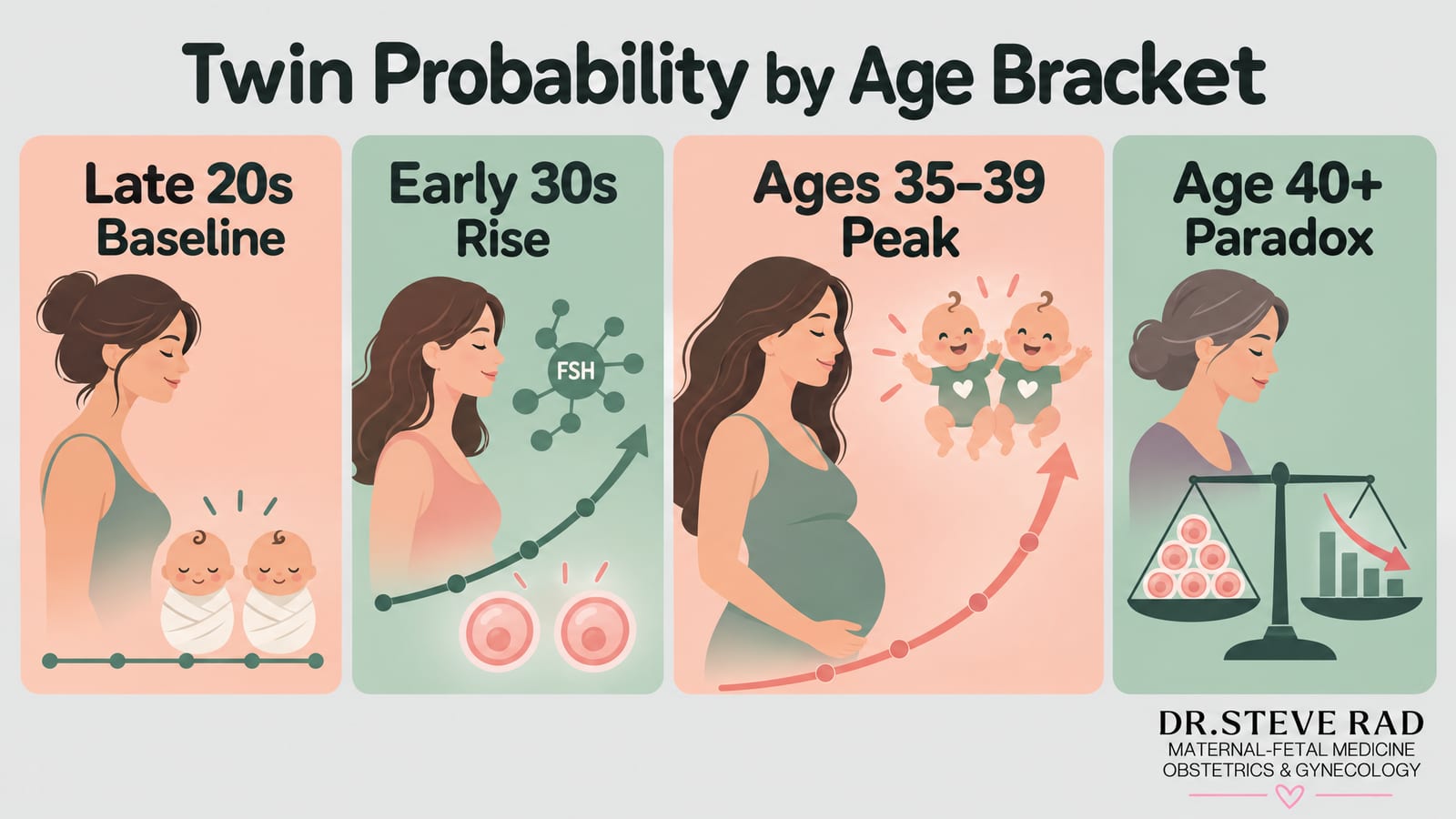
Late 20s: Twin rates are close to the general population baseline of 2% to 4% of births. FSH levels are relatively stable, and spontaneous dizygotic twinning is less common.
Early 30s: FSH begins a gradual rise. Women in their early 30s are noticeably more likely to release more than one egg per cycle than women in their 20s, nudging twin odds upward.
Ages 35 to 39: This is the window where the twin rate climbs most sharply. Women in this bracket are roughly twice as likely to conceive fraternal twins as women under 20, and maternal age 35 is the clinical threshold for advanced maternal age (AMA).
Age 40 and older: FSH levels are at their highest, which paradoxically increases the chance of releasing multiple eggs even as overall fertility declines. Spontaneous twin rates remain elevated, though IVF becomes a more common path to pregnancy at this age.
These figures reflect spontaneous conception. Fertility treatment can raise the odds considerably further, as discussed below.
What Is Considered Advanced Maternal Age?
The American College of Obstetricians and Gynecologists (ACOG) defines advanced maternal age as being 35 or older at the time of delivery. With the average American woman’s life expectancy now at 79 years, according to the CDC, 35 may not feel like a significant milestone – but biologically, it marks a turning point worth understanding. As the body approaches the mid-30s, the pituitary gland begins releasing higher levels of follicle-stimulating hormone (FSH) to compensate for declining ovarian reserve. That FSH surge can stimulate the ovaries to release more than one egg in a single cycle, which is precisely why spontaneous dizygotic (fraternal) twin rates climb steadily from age 35 onward. In other words, the same hormonal shift that signals reduced fertility can, somewhat paradoxically, increase the likelihood of a twin pregnancy – and with it, the complexity of the pregnancy itself.
For women navigating pregnancy at 35 or beyond, understanding this connection between age, FSH, and twin risk is an important first step. A twin pregnancy at advanced maternal age is automatically considered high-risk, which is why early consultation with a maternal-fetal medicine specialist like Dr. Rad can make all the difference in how confidently and safely you move through each trimester. That is the Dr. Rad difference – personalized, expert care from the very beginning.

Call (844) 473-6100 or click here to schedule online
What Is Delaying Pregnancy?
CDC data show the average age at first birth rose from 21 in 1970 to 26 in 2020, as more women prioritize career, financial stability, or simply haven’t found the right partner earlier in life. This shift means a growing number of women are now asking about their chances of having twins after 35 – and the biology gives them good reason to. This trend matters for twin risk because every year of delay brings FSH levels higher, increasing the likelihood of hyperovulation and a dizygotic twin pregnancy during a singleton pregnancy attempt. In practical terms, a woman who conceives naturally at 35 or older is meaningfully more likely to release two eggs in a single cycle than she was in her 20s – making delayed pregnancy one of the most underappreciated drivers of rising twin rates.
Who Is More Likely to Have Twins?
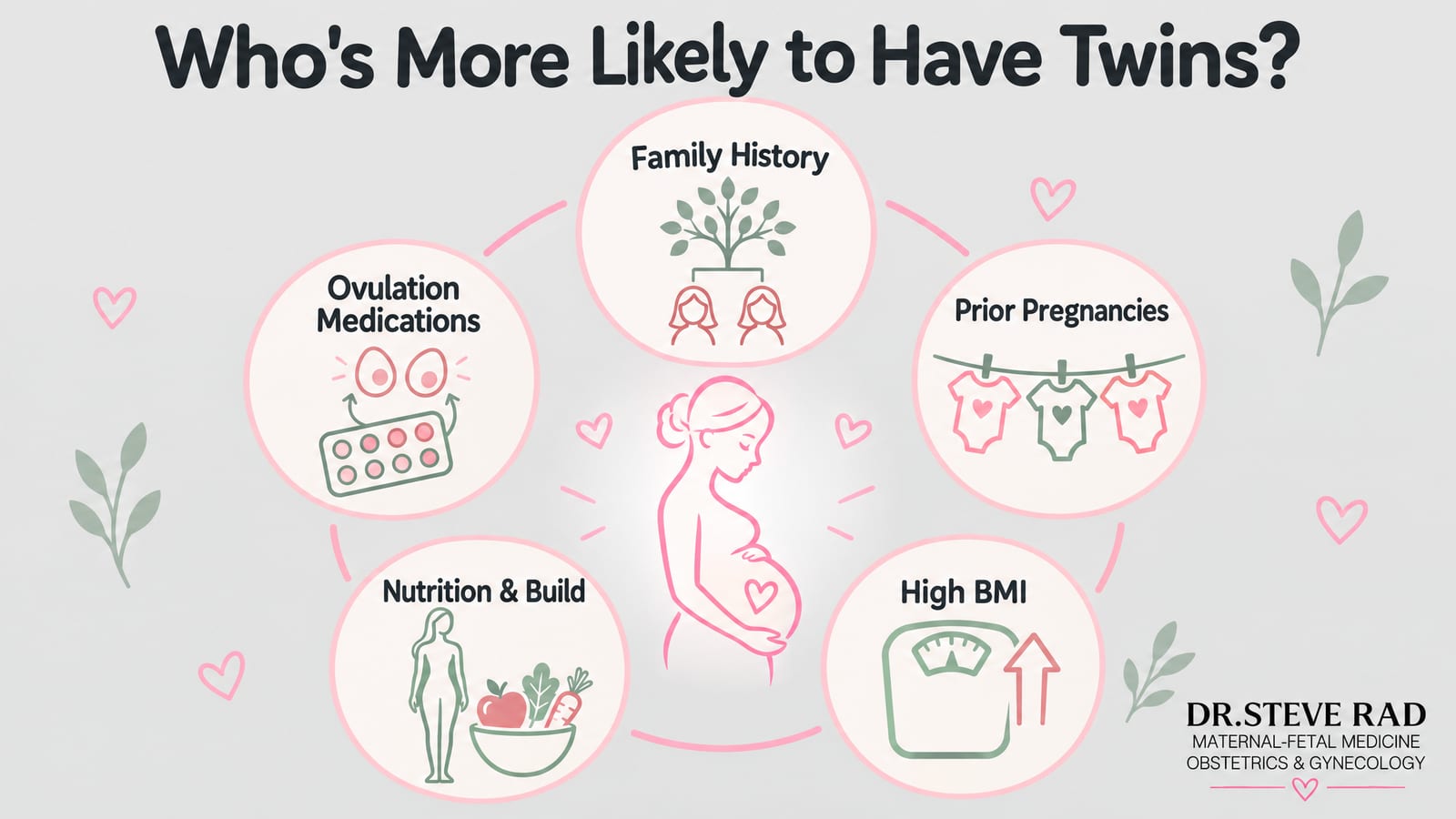
Age is the most discussed factor, but several others independently raise the dizygotic twin rate. Here is what the research actually shows for each one:
Family history: A person with a close relative – parent or sibling – who has had fraternal twins is estimated to be twice as likely to conceive twins themselves. This hereditary tendency toward hyperovulation is passed down on the maternal side. Importantly, the gene only influences your own ovulation pattern – carrying it on the paternal side does not raise your personal odds of releasing two eggs.
Higher BMI: Individuals with a BMI of 30 or above have a statistically higher rate of twin pregnancies, likely because excess body fat raises circulating estrogen and FSH levels, promoting multi-follicle development. One widely cited study found that women with a BMI over 30 were roughly 1.5 times more likely to conceive fraternal twins than women in the normal BMI range – a meaningful difference that researchers attribute to elevated FSH driving simultaneous maturation of more than one follicle.
Nutrition and physical build: Research has linked taller stature and diets rich in dairy products to modestly higher twin rates, possibly through insulin-like growth factor (IGF), which influences ovarian response to FSH. A study by Dr. Gary Steinman found that women who consumed dairy were about five times more likely to have twins than those following a vegan diet, suggesting that IGF present in cow’s milk may amplify the ovaries’ sensitivity to follicle-stimulating signals.
Parity: Having been pregnant before raises your odds of multiples with each subsequent pregnancy – partly because you are older each time, and partly because prior pregnancies may prime the body toward releasing multiple eggs. Some estimates suggest that by a fourth or fifth pregnancy, the likelihood of twins can be nearly double that of a first pregnancy, even when age is held constant.
Ovulation-stimulating medications: Drugs such as clomiphene (Clomid) and letrozole, used in ovulation induction and intrauterine insemination (IUI) cycles, stimulate the ovaries to produce multiple follicles. This significantly raises the chance of a dizygotic twin pregnancy compared to unassisted conception. Studies estimate that clomiphene alone increases the twin rate to roughly 5-8% per cycle – several times higher than the natural background rate of around 1-2%.
IVF and embryo transfer: Transferring more than one embryo during IVF raises twin odds directly. Many clinics now recommend elective single embryo transfer (eSET) to reduce that risk, particularly in younger patients with good-quality embryos. Even so, twin rates from IVF remain notably higher than natural conception – and for women over 35 pursuing IVF, the conversation around how many embryos to transfer becomes especially important, since both twin pregnancies and advanced maternal age independently elevate the risk of complications. This is exactly the kind of nuanced, high-stakes decision where working with a maternal-fetal medicine specialist like Dr. Rad makes a real difference.
What Are the Chances of Twins in the 4th Pregnancy?
If you’ve already had three pregnancies and are wondering whether your chances of having twins go up with a fourth, the short answer is yes – and it’s more than just a coincidence. Research consistently shows that the more pregnancies you’ve had, the higher your likelihood of conceiving fraternal (dizygotic) twins. This is sometimes called the “grand multiparity” effect, and it’s one of the more fascinating patterns in reproductive medicine.
Why does this happen? With each pregnancy, your body becomes increasingly efficient at releasing eggs during ovulation. Over time, hormonal shifts – particularly rising levels of follicle-stimulating hormone (FSH) – can prompt your ovaries to release more than one egg in a single cycle. More eggs released means a greater chance that two get fertilized at the same time.
By the time you reach a fourth pregnancy, studies suggest your twin probability can be nearly four times higher than that of a first-time mother. When you layer in other factors – being over 35, having a family history of fraternal twins, or carrying a higher body weight – those odds climb even further. It’s worth noting that high-risk pregnancies are becoming more common overall, and a fourth pregnancy with twins absolutely falls into that category.
If you’re planning a fourth pregnancy and want to understand your personal risk profile, speaking with a maternal-fetal medicine specialist early makes all the difference.
What Are the Chances of Twins in IVF?
IVF raises twin odds beyond what age alone produces, though the relationship between IVF and twins is more nuanced than many people expect. Interestingly, the likelihood of a twin pregnancy through IVF actually decreases as maternal age rises. Among women under 35, roughly 12% of IVF transfers result in twins. That figure drops to about 9.1% for women aged 35 to 37, and continues to decline in older age brackets – largely because embryo quality decreases and reproductive medicine clinics are more likely to recommend single embryo transfer.
IVF-conceived twins are almost always fraternal (dizygotic), since clinics transfer two separate embryos. Monochorionic (identical) twins from IVF are rare. The growing adoption of eSET has reduced IVF twin rates overall, but multiples remain more common through assisted reproduction than through unassisted conception.
Call (844) 473-6100 or click here to schedule online

However, twin chances from assisted reproductive technology based on age aren’t linear. If you’re under age 35 and undergoing IVF with fresh embryos, your chance of having twins is around 12%. However, if you’re between 35 and 37, it drops down to 9.1%. Your chance of having twins with IVF actually keeps decreasing as you age, unlike your chances of conceiving twins naturally.
Why Are Twin Pregnancies High-Risk?
Individuals pregnant with more than one baby are almost always considered higher risk than those with a singleton pregnancy. Expecting multiples increases the chance of obstetric and neonatal complications. High-risk pregnancy conditions in twin pregnancies can include:
High blood pressure (preeclampsia)
Gestational diabetes
Congenital abnormalities
Growth restriction
Low birth weight
Preterm labor and preterm birth
Twin-to-twin transfusion syndrome (TTTS) in monochorionic twins
Increased risk of cesarean section
Advanced maternal age adds its own layer of risk, including spontaneous miscarriage, hypertension, chromosomal abnormalities, and prematurity. When a twin pregnancy and AMA overlap, specialist oversight becomes especially important.
That is where a maternal-fetal medicine specialist – a perinatologist – makes a real difference. Specialist monitoring for a twin or AMA pregnancy typically includes more frequent anatomy scans, cervical length monitoring to assess preterm labor risk, and genetic counseling to discuss chromosomal screening options. For monochorionic twins, closer ultrasound surveillance is essential to detect complications like TTTS early. If you are over 35 and expecting twins, seeking care from a perinatologist as early as possible – ideally in the first trimester – gives your care team the best opportunity to establish a baseline, identify any concerns, and build a personalized monitoring plan around your specific risk profile. State-of-the-art tools like Dr. Rad’s cutting-edge 3D and 4D ultrasound technology, along with early fetal scans and fetal echocardiograms available as early as 11 to 16 weeks, mean that potential complications can be spotted and addressed well before they escalate. We understand pregnancy can feel overwhelming, and Dr. Rad’s Maternal-Fetal Medicine team is experienced in guiding patients through exactly these complexities – treating every patient as a VIP and ensuring you feel supported at every step. That is the Dr. Rad difference.
Considering Pregnancy? Talk to Dr. Rad First
Perinatologist Dr. Rad and his world-class Maternal-Fetal Medicine team at Los Angeles Fetal and Maternal Care Center understand your pregnancy needs before, during, and after birth. Whether you are navigating a twin pregnancy, an advanced maternal age pregnancy, or both, we provide compassionate, expert care and the emotional support you need to move forward with confidence.
We are currently accepting new patients. Call us at (844) 473-6100 or schedule your consultation online.
We are conveniently located for patients throughout Southern California and the Los Angeles area at locations in or near Beverly Hills, Santa Monica, West Los Angeles, West Hollywood, Culver City, Hollywood, Venice, Marina del Rey, Malibu, Manhattan Beach, Newport Beach, Irvine, and Downtown Los Angeles. We also offer in-home prenatal care and a fly-in program for out-of-town and international patients. Dr. Rad even travels to patients who need him throughout the U.S. and around the world. Virtual consultations are also available worldwide.
Call (844) 473-6100 or click here to schedule online