What is prenatal genetic testing?
Prenatal genetic testing is a collection of medical tests offered during pregnancy to assess whether a baby is at increased risk of, or is confirmed to have, a chromosomal abnormality or inherited genetic condition. These tests give expectant parents and their care team the information they need to make informed decisions, plan appropriate care, and, in some cases, pursue treatment before birth.

Prenatal genetic testing is not a single test. It is a spectrum of options, each with a different purpose, timing, and level of certainty. Tests fall into two broad categories:
Screening tests estimate the statistical probability that a baby has a particular condition. They are non-invasive and carry no procedural risk, but they cannot confirm a diagnosis. A positive screening result means increased risk, not a definitive answer.
Diagnostic tests analyze the baby’s actual genetic material and can confirm or rule out a condition with a high degree of certainty. They are invasive procedures and carry a small but real procedural risk.
Understanding this distinction is one of the most important things you can do before your first appointment. At our center, we take the time to walk you through every option clearly, so you never feel overwhelmed or alone in this process. We understand pregnancy can be a vulnerable and anxious time, and that is the Dr. Rad difference.
Prenatal genetic testing is distinct from preconception carrier screening, which is performed before pregnancy to determine whether either parent carries a gene mutation they could pass to a child. Both are valuable, and we offer both at our center. The sections below explain each type in plain language.
Carrier screening: before and during pregnancy
Carrier screening analyses a blood or saliva sample from one or both parents to determine whether they carry a mutation in a gene associated with a heritable condition. Being a carrier means you carry one copy of a mutated gene but are typically healthy yourself. When both parents carry a mutation in the same gene, each pregnancy carries a 1-in-4 chance that the child inherits both copies and is affected.
According to the American College of Obstetricians and Gynecologists (ACOG), offer carrier screening to all couples considering pregnancy or in the early stages of pregnancy, regardless of ethnicity or family history. Expanded carrier screening panels now test for hundreds of conditions simultaneously, including:
Cystic fibrosis, caused by mutations on chromosome 7 and one of the most common serious genetic conditions among people of European descent
Sickle cell disease, which disproportionately affects people of African, Mediterranean, Middle Eastern, and South Asian ancestry
Spinal muscular atrophy (SMA), a leading genetic cause of infant death
Fragile X syndrome, the most common inherited cause of intellectual disability
Thalassemia, caused by mutations in both parents and more prevalent in people of Mediterranean, African, and South-East Asian descent
Dr. Steve Rad holds rare dual training in medical genetics and genetic counseling, as well as advanced education in communication and psychology. This means he can not only interpret your results with clinical precision but also help you understand what they mean for your family in a clear, compassionate way, free of unnecessary alarm. Los Angeles patients consistently tell us this combination makes all the difference.

Ethnicity also impacts a couple’s risk of carrying genetic diseases. Ashkenazi (Eastern European) Jewish populations are at increased risk of Tay-Sachs disease, African Americans are more likely to carry sickle cell anemia, the Mediterranean population is at higher risk for thalassemia, and people of Northern European descent could be carriers of cystic fibrosis.
Who should consider prenatal genetic testing?
ACOG recommends that prenatal genetic testing options be discussed with every pregnant patient. Certain factors make testing particularly important to consider:
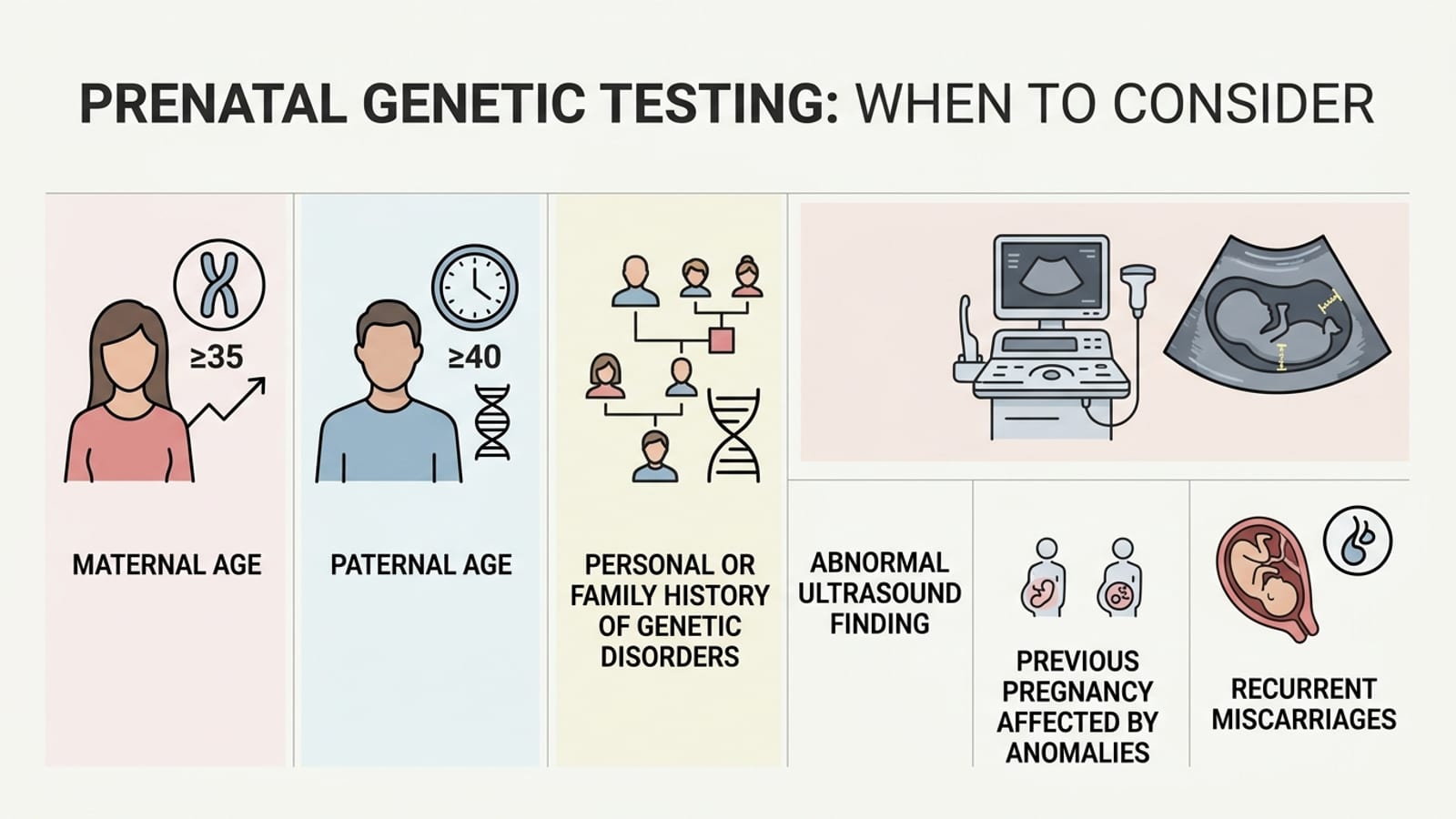
Advanced maternal age (35 or older at delivery), as the risk of chromosomal abnormalities such as Down syndrome increases with age
Advanced paternal age (40 or older at delivery)
A personal or family history of birth defects, chromosomal conditions, or inherited genetic disorders
An abnormal finding on a prenatal ultrasound, such as increased nuchal translucency measurement
A previous pregnancy affected by a chromosomal abnormality or structural anomaly
Abnormal results from a prior screening test during the current pregnancy
Recurrent miscarriages, which are often linked to chromosomal factors
Consanguinity (parents who are biologically related)
Even if none of these factors apply to you, many patients choose prenatal genetic testing simply for the reassurance it provides. We treat all patients as VIPs, ensuring you feel cared for and supported whatever your reason for seeking testing.
Screening tests vs. diagnostic tests: what’s the difference?
One of the most common points of confusion in prenatal genetic testing is the difference between a screening test and a diagnostic test – and honestly, it’s an important distinction that can save a lot of anxiety if you understand it upfront.
A screening test estimates the probability that your baby has a certain condition. It doesn’t give you a yes or no answer – it tells you whether your risk is higher or lower than average. Tests like cell-free DNA (NIPT), first-trimester combined screening, and maternal serum screening all fall into this category. They’re non-invasive, carry no risk to the pregnancy, and are a great first step for most expectant parents. A “positive” or “high-risk” result simply means further investigation is recommended – it is not a diagnosis.
A diagnostic test, on the other hand, can confirm or rule out a condition with much higher certainty. Chorionic villus sampling (CVS) and amniocentesis are the two main options. Both involve collecting a small sample of placental tissue or amniotic fluid to directly analyze your baby’s chromosomes. Because they are invasive procedures, they carry a small risk of pregnancy complications, which is why they’re typically offered after a screening test returns a concerning result – or when there’s already a known family history or ultrasound finding that warrants a closer look.
Understanding this two-step process helps you feel more in control of your decisions. If you’re navigating a high-risk pregnancy and want guidance on which path makes sense for your situation, getting a specialist’s perspective early can make all the difference. That personal, unhurried guidance is at the heart of what Dr. Rad provides to every patient.
Types of prenatal genetic tests: a plain-language guide
Below is an overview of the main prenatal genetic tests, when they are performed, what they detect, and what results mean. Our team will help you choose the combination that fits your circumstances.
First-trimester combined screening (weeks 10-13)
First-trimester combined screening brings together two components to estimate the risk of the most common chromosomal abnormalities:
Nuchal translucency (NT) ultrasound: a specialized ultrasound that measures the fluid-filled space at the back of the baby’s neck. An increased measurement can indicate a higher risk of Down syndrome (trisomy 21), trisomy 18 (Edwards syndrome), trisomy 13 (Patau syndrome), and certain heart defects.
Blood tests: measuring pregnancy-associated plasma protein-A (PAPP-A) and human chorionic gonadotropin (hCG) in the mother’s blood.
Combined, these results produce a risk estimate. This is a screening test, so a high-risk result does not mean your baby has a chromosomal condition. It means further testing, such as cell-free DNA screening or a diagnostic procedure, is recommended.
NIPT: cell-free DNA screening (from week 10)
Non-invasive prenatal testing (NIPT), also called cell-free DNA (cfDNA) screening, is one of the most significant advances in prenatal care of the past decade. It analyses small fragments of the baby’s DNA that circulate in the mother’s bloodstream, requiring only a simple maternal blood draw.
NIPT can screen for:
Down syndrome (trisomy 21), the most common chromosomal abnormality, caused by an extra copy of chromosome 21
Trisomy 18 (Edwards syndrome), caused by an extra copy of chromosome 18, associated with severe developmental problems
Trisomy 13 (Patau syndrome), caused by an extra copy of chromosome 13
Sex chromosome conditions, including Turner syndrome (45,X) and Klinefelter syndrome (47,XXY)
Certain microdeletion syndromes, depending on the panel selected
NIPT has a high sensitivity and specificity for the conditions it screens for, with detection rates for Down syndrome exceeding 99% in high-risk populations. However, it remains a screening test, not a diagnostic test. It has a false-positive rate, meaning some positive results will not be confirmed by diagnostic testing. Always follow up a positive NIPT result with a diagnostic procedure before making any irreversible decisions.
NIPT can be performed from around 10 weeks of pregnancy and is available to all pregnant patients, not only those at elevated risk.
Second-trimester quad screen (weeks 15-20)
The quadruple marker test (quad screen) is a second-trimester blood test that measures four substances in the mother’s blood: alpha-fetoprotein (AFP), hCG, estriol, and inhibin A. The results are used to estimate the risk of:
Down syndrome (trisomy 21)
Trisomy 18 (Edwards syndrome)
Neural tube defects, including spina bifida and anencephaly
Abdominal wall defects
The quad screen is particularly useful for patients who did not have first-trimester screening, or as part of an integrated screening approach. Like all screening tests, it estimates risk rather than confirming a diagnosis.
Chorionic villus sampling (CVS) – diagnostic (weeks 10-13)
Chorionic villus sampling (CVS) is a diagnostic procedure performed in the first trimester. A small sample of placental tissue (chorionic villi) is taken through the cervix or abdomen under ultrasound guidance. Because the placental cells share the baby’s genetic material, CVS can provide a definitive chromosomal diagnosis.
CVS can detect chromosomal abnormalities such as Down syndrome, trisomy 18, and trisomy 13, as well as single-gene disorders when a specific condition is being tested for. Results are typically available within one to two weeks.
As an invasive procedure, CVS carries a small risk of pregnancy loss, estimated at approximately 0.5-1%. Weigh this risk carefully against the benefit of a definitive first-trimester diagnosis, and our team will help you think through this decision with care and without pressure.
Amniocentesis – diagnostic (weeks 15-20)
Amniocentesis is the most widely used diagnostic prenatal test. A fine needle is inserted through the abdomen under continuous ultrasound guidance to withdraw a small sample of amniotic fluid, which contains cells shed by the baby. These cells are cultured and analyzed to produce a complete chromosomal picture (karyotype) or to test for specific genetic conditions.
Amniocentesis can diagnose:
Chromosomal abnormalities, including Down syndrome, trisomy 18, trisomy 13, Turner syndrome, and Klinefelter syndrome
Neural tube defects (via AFP measurement in the fluid)
Specific single-gene disorders when indicated by carrier screening or family history
The procedure-related risk of miscarriage with amniocentesis is approximately 0.1-0.3%, lower than that of CVS. Results are typically available within two weeks, though rapid FISH testing can provide preliminary chromosomal results within 24-48 hours.
Both CVS and amniocentesis are performed at our center by experienced specialists under careful ultrasound guidance, with your comfort and safety as the absolute priority.
Risks and safety of prenatal genetic testing
One of the first questions patients ask us is, “Is this safe for my baby?” It’s a completely understandable concern, and we want to give you a straight, honest answer.
The good news is that most prenatal genetic tests carry no physical risk. Non-invasive options like cell-free DNA (NIPT), first-trimester blood screening, and carrier screening involve nothing more than a routine blood draw from you – there’s zero risk to your baby from these tests.
The picture is slightly different for diagnostic procedures like CVS and amniocentesis, because both involve inserting a needle into the uterus. That does carry a small but real risk of pregnancy loss. For CVS, performed between weeks 10 and 13, the miscarriage risk is approximately 0.5-1%. For amniocentesis, performed between weeks 15 and 20, that risk is lower – roughly 0.1-0.3%. Other temporary side effects, such as mild cramping or spotting, can occur but typically resolve quickly.
It’s important to put those numbers in context. For many families – especially those navigating high-risk pregnancies – the certainty a diagnostic test provides far outweighs the small procedural risk. A skilled, experienced provider also makes a meaningful difference; technique matters enormously with these procedures.
At our practice, Dr. Rad walks you through every risk and benefit before scheduling any procedure. We believe informed patients make empowered decisions, and we’re here to support you every step of the way – because that’s the Dr. Rad difference.
What prenatal genetic testing can reveal
Prenatal genetic tests screen for or diagnose a range of chromosomal abnormalities and genetic conditions. The most commonly tested for include:
Down syndrome (trisomy 21): the most common chromosomal condition, occurring in approximately 1 in 700 births. Risk increases with maternal age.
Trisomy 18 (Edwards syndrome): a serious chromosomal condition associated with significant developmental abnormalities.
Trisomy 13 (Patau syndrome): a chromosomal condition associated with severe intellectual disability and physical abnormalities.
Turner syndrome (45,X): a sex chromosome condition affecting females, associated with short stature and fertility challenges.
Klinefelter syndrome (47,XXY): a sex chromosome condition affecting males, often with mild effects that may not be apparent until adulthood.
Neural tube defects: including spina bifida and anencephaly, which result from incomplete closure of the neural tube in early development.
Sickle cell disease, cystic fibrosis, SMA, fragile X syndrome, and thalassemia: single-gene disorders detectable through carrier screening and, where indicated, diagnostic testing.
Understanding what testing can and cannot detect is an important part of the counseling process. No test screens for every possible condition, and a normal result does not guarantee a healthy baby. Our team will always be honest with you about what the results do and do not tell us.
What testing reveals about preterm birth risk
Genetic research has also shed important light on the causes of preterm birth. The largest genome-wide study of preterm birth ever conducted included more than 50,000 pregnancies and identified the location of at least six genes whose expressions play a significant role in causing conditions that bring about preterm birth. The study culminated decades of scientific research and the latest innovations in genetic technology.
Dr. Louis Muglia of the March of Dimes Prematurity Research Center noted: “Overall, genetics probably contributes to between 25% and 40% of all preterm births, and the genes we identified probably represent an even smaller percentage of that, but individually, they might increase or decrease a woman’s chances of having a preterm birth by 10 to 20%. The research findings also help us understand the pathways the genes affect.”
This research underscores why a thorough genetic assessment during pregnancy is about far more than chromosomal conditions. It is about understanding the full picture of your pregnancy’s health.
What testing reveals about pregnancy loss
Human reproduction can be remarkably inefficient. Statistics reveal that 10-30% of all pregnancies end in miscarriage. Of those, approximately 5% of women will experience repeated miscarriages, with more than 50% of them never receiving an underlying diagnosis.
Advances in molecular technology have led to breakthroughs in understanding the genetic contributions to pregnancy loss. Recent studies have demonstrated that abnormal changes in the genes of pregnant women may contribute to pregnancy loss, allowing for better management and guidance in lowering the risk of recurrence.
Our center offers both non-invasive and invasive genetic testing, with access to state-of-the-art chromosomal micro-array (CMA) and whole exome sequencing (WES) for cases of pregnancy loss or fetal anomaly where standard testing has not provided answers. These advanced tools can identify genetic variants that conventional karyotyping would miss, giving families the answers and closure they deserve.

Call (844) 473-6100 or click here to schedule online
What happens during a genetic counseling consultation?
Your consultation with Dr. Rad will include a thorough discussion and review of your personal and family medical histories, medical records from previous pregnancies (including any complications), prior pregnancy ultrasounds, and any existing prenatal results. We recommend speaking with family members before your appointment, where possible, to bring an accurate record of relevant health conditions.
Dr. Rad will explain all testing options relevant to your situation, including which screening and diagnostic tests are appropriate for your stage of pregnancy, your risk profile, and your personal preferences. He will also explain what results mean in practical terms, and what your options are at each stage. Our center provides the full spectrum of genetic counseling services and collaborates with renowned genetic specialists who are available to consult at any time.
Your options after genetic testing
If genetic testing reveals that you or your partner carry a mutation, or that a current pregnancy is affected by a chromosomal or genetic condition, there are several paths forward. Our role is to make sure you understand every option clearly, without pressure, and with full emotional support.
Continuing the pregnancy with enhanced monitoring: many patients choose to continue their pregnancy with more frequent prenatal screening and specialist oversight from the first trimester onward. Knowing about a condition in advance allows the care team to plan for the best possible birth and neonatal outcome.
Preimplantation genetic testing (PGT): for couples who are carriers of a known genetic condition and are considering IVF, PGT screens embryos before transfer. PGT-A (preimplantation genetic testing for aneuploidies) screens for chromosomal abnormalities, while PGT-M (preimplantation genetic testing for monogenic disorders) tests for specific single-gene conditions. Clinicians transfer only unaffected embryos, significantly reducing the risk of an affected pregnancy.
Donor egg or donor sperm: using a donor whose genetic profile does not carry the relevant mutation is another option for at-risk couples, allowing for a healthy pregnancy while maintaining a biological connection for one partner.
Adoption: for some families, adoption is the right path, and we are happy to support you in exploring this option with the same care and respect we bring to every conversation.
Whatever path you choose, we are here to support you every step of the way.

In vitro fertilization (IVF) is another option for carriers of genetic conditions. With IVF, the embryos can undergo preimplantation genetic diagnosis. This testing lets clinicians identify the healthiest embryo and implant it, rather than leaving it to chance.
In utero surgery: when testing identifies a treatable anomaly
One of the most remarkable aspects of care at our center is that for some conditions identified through prenatal genetic testing, treatment does not have to wait until birth. As one of the most comprehensive fetal care centers in the region, we treat dozens of fetal anomalies to ensure the best possible pregnancy outcome.
Our multidisciplinary team includes renowned expert specialists across our hospital network, and our center has a dedicated Fetal Genetic Disorders testing program and a Fetal Surgery Program. Fetal surgery is an extraordinarily complex, precise surgical intervention to repair birth defects in the womb. Conditions that may be amenable to in utero intervention or specialist management include:
Spina bifida, which may result from a combination of genetic, nutritional, and environmental risk factors
Cystic fibrosis, caused by a genetic mutation on chromosome 7 and one of the most common genetic conditions among people of European descent, with approximately 1,000 new cases diagnosed every year
Thalassemia, a genetic disorder caused by mutations in both parents, occurring more frequently in people of African, Mediterranean, and South-East Asian descent
Congenital diaphragmatic hernia, which may result from a genetic disorder or occur without an identifiable genetic cause
Congenital heart defects, which may result from various genetic conditions and syndromes, rubella, or environmental factors. Congenital heart defects are the most common type of congenital disability, affecting approximately eight in every 1,000 newborns
Knowing about these conditions before birth, through comprehensive prenatal genetic testing, is what makes early intervention possible. That is the Dr. Rad difference.
Frequently asked questions about prenatal genetic testing
How accurate is NIPT/cell-free DNA testing?
NIPT is highly accurate for the conditions it screens for. Detection rates for Down syndrome (trisomy 21) exceed 99% in high-risk populations, with a low false positive rate of less than 0.1% for trisomy 21. However, accuracy can be lower for rarer conditions and for sex chromosome abnormalities. NIPT is also a screening test, not a diagnostic test. Always confirm a positive result with CVS or amniocentesis before making any decisions.
Is prenatal genetic testing covered by insurance?
Coverage varies by insurer and by test type. NIPT is typically covered for patients considered high risk, including those of advanced maternal age (35 or older) or with a prior affected pregnancy. Coverage for low-risk patients is improving but is not universal. Carrier screening is increasingly covered as a standard part of prenatal care. Diagnostic tests such as CVS and amniocentesis are generally covered when medically indicated. Our team can help you navigate your insurance benefits and understand your out-of-pocket costs before you commit to any testing.
What happens if my results are abnormal?
An abnormal screening result does not mean your baby has a condition. It means the risk is elevated and further evaluation is recommended. If a diagnostic test confirms a chromosomal abnormality or genetic condition, Dr. Rad and our team will walk you through what the diagnosis means in practical terms, the range of outcomes, and your options. You will never receive difficult news and be left without support. We are here to help you understand, process, and plan, at whatever pace you need.
When can I have prenatal genetic testing?
NIPT and CVS can both be performed from around 10 weeks of pregnancy, making first-trimester testing possible for patients who want early answers. Nuchal translucency ultrasound is performed between 11 and 13 weeks. Amniocentesis and the quad screen are second-trimester tests, typically performed between 15 and 20 weeks. Our team will recommend the most appropriate timing based on your individual circumstances and preferences.
What is the difference between a screening test and a diagnostic test?
A screening test estimates the probability that your baby has a particular condition. It is non-invasive and safe, but it cannot give a definitive yes-or-no answer. A diagnostic test analyses the baby’s actual genetic material and can confirm or rule out a condition with a high degree of certainty. Diagnostic tests are invasive and carry a small procedural risk. Most patients begin with screening and proceed to diagnostic testing only if a result is abnormal or if they want a definitive answer from the outset.
About Dr. Rad and our team
Perinatologist Dr. Rad and his world-class Maternal-Fetal Medicine (MFM) obstetrics and gynecology team at Los Angeles Fetal and Maternal Care understand your high-risk OB and infertility needs before, during, and after birth. We provide compassionate care, help you understand your pregnancy, answer your questions, and offer the emotional support you need to navigate your pregnancy safely.
Dr. Rad has undergone rigorous training with the highest honors at prestigious institutions including the David Geffen School of Medicine at UCLA, the University of Southern California, Cedars-Sinai Medical Center, UCSF Medical Center, and centers internationally, including London, Austria, Israel, and Africa. His rare combination of expertise in medical genetics, genetic counseling, and patient communication means you receive both clinical excellence and genuine human care.
We are conveniently located for patients throughout Southern California and the Los Angeles area, with locations in or near Beverly Hills, Santa Monica, West Los Angeles, West Hollywood, Culver City, Hollywood, Venice, Marina del Rey, Malibu, Manhattan Beach, Newport Beach, Irvine, and Downtown Los Angeles. We also offer in-home prenatal care and a fly-in program for out-of-town and international patients. Dr. Rad travels to patients who need him throughout the United States and worldwide.
If you cannot make it to us in person, Dr. Rad also offers virtual consultations worldwide. Call us at (844) 473-6100 or schedule your consultation online. We are currently accepting new patients.
Call (844) 473-6100 or click here to schedule online