Should I Have a Cerclage Procedure?
Women navigating high-risk pregnancies in the Greater Los Angeles area rely on Dr. Steve Rad, a double-board-certified obstetrician-gynecologist with subspecialty training in Maternal-Fetal Medicine (MFM). Dr. Rad practices with a conservative, evidence-based hand, always putting your welfare first and ensuring you feel genuinely supported at every step.
One of the most important conversations Dr. Rad has with his patients involves cervical cerclage, a surgical procedure that can be highly effective at preventing preterm birth caused by cervical insufficiency (also called an incompetent or weak cervix). The procedure is successful in almost 90% of cases. That said, diagnosing cervical insufficiency can be genuinely difficult and is sometimes inaccurate, which is why having a specialist with MFM training evaluate your individual history matters so much. That is the Dr. Rad difference.

What Is a Cervical Cerclage?
A cervical cerclage is a surgical procedure in which a doctor places a strong suture – or, in some cases, a synthetic band – around the cervix to hold it closed during pregnancy. Think of it as a reinforcing stitch that supports a cervix that might otherwise open too early, before the baby is ready to be born.
The cervix is the lower, narrow end of the uterus that connects to the vagina. Under normal circumstances, it stays long and firm throughout most of pregnancy, then gradually softens and opens as labor approaches. In women with certain high-risk pregnancy conditions, this process can begin far too early – often silently and without painful contractions – leaving the pregnancy vulnerable. Cerclage is one of three main strategies used to address this risk, alongside progesterone supplementation and a cervical pessary.
There are two broad approaches to cerclage placement: transvaginal (through the vagina) and transabdominal (through the abdomen). Which approach is right for you depends on your individual history, anatomy, and how far along your pregnancy is – all factors that Dr. Rad evaluates carefully as part of his concierge, patient-first approach to maternal-fetal medicine. Within those approaches, surgeons use several specific techniques, described in detail below.
Why Is Cervical Cerclage Done? Understanding Cervical Insufficiency
Before pregnancy, the cervix is long, firm, and tightly closed. During pregnancy, hormonal changes cause the cervix to gradually shorten (efface), soften, and open (dilate). In women with cervical insufficiency, this process begins too early, typically in the second trimester, often without any warning pain or contractions. The result can be pregnancy loss or preterm birth.
Research confirms that cervical cerclage reduces the risk of premature delivery in women with proven cervical insufficiency. However, the timing of the procedure matters significantly. Emergency cerclage performed in the presence of advanced cervical change and prolapsed membranes carries a poorer prognosis than cerclage placed earlier, which is why early evaluation and monitoring are so important.
One of the honest realities of cervical insufficiency is that it can be genuinely difficult to diagnose. There is no single definitive test – the condition is identified through a combination of obstetric history, physical examination, and cervical length monitoring. This is why working with a maternal-fetal medicine specialist like Dr. Rad, rather than navigating a high-risk pregnancy alone, makes such a meaningful difference in outcomes.
Dr. Rad evaluates each patient individually, drawing on cervical length monitoring via transvaginal ultrasound, detailed obstetric history, and physical examination to determine whether cerclage is the right intervention. Transvaginal ultrasound is the gold standard for measuring cervical length and is far more accurate than a standard abdominal scan. Dr. Rad uses state-of-the-art ultrasound technology to track cervical length across multiple appointments, building a clear picture of how your cervix is behaving throughout pregnancy. This kind of close, continuous monitoring is a cornerstone of the concierge, VIP care that defines the Dr. Rad difference. Candidates are generally classified into one of three clinical categories:
History-Indicated Cerclage
Also called elective or prophylactic cerclage, this type is offered to women with a clear history of second-trimester pregnancy losses or prior cerclage placements related to painless cervical dilation. It is typically placed between 12 and 14 weeks of pregnancy, before any cervical change is visible. If your obstetric history strongly suggests cervical insufficiency, Dr. Rad may recommend this approach as a planned, proactive measure. Because this cerclage is scheduled in advance, it allows for thorough preparation, a calm clinical environment, and the best possible conditions for a successful outcome.
Ultrasound-Indicated Cerclage
Some women have no prior history of pregnancy loss but are found on routine transvaginal ultrasound to have a short cervix, generally defined as a cervical length of less than 25 mm before 24 weeks of pregnancy. This finding, especially when combined with a history of preterm birth, may prompt an ultrasound-indicated cerclage. Regular cervical length monitoring is a cornerstone of Dr. Rad’s high-risk pregnancy care, allowing him to catch this change early when intervention is most effective. This is precisely why consistent prenatal monitoring matters so much – a cervix that looks normal at 16 weeks can shorten significantly by 20 weeks, and catching that shift early is what gives cerclage the best chance of working.
Exam-Indicated (Rescue) Cerclage
Sometimes called an emergency or rescue cerclage, this procedure is performed when a physical exam shows the cervix has already begun to dilate or efface, or when the amniotic membranes are visible at or near the cervical opening. This is the highest-risk scenario, and outcomes are less predictable, but rescue cerclage can still extend the pregnancy meaningfully in carefully selected patients. In these urgent situations, having immediate access to a renowned perinatology specialist is critical. Dr. Rad’s 24/7 availability means that when you need to make time-sensitive decisions, you are never left waiting or navigating an unfamiliar emergency room alone. Dr. Rad’s expertise in maternal-fetal medicine means he can assess these complex situations with the clinical precision they demand.
Who Is Not a Candidate for Cerclage?
Cervical cerclage is not appropriate for every patient at risk for preterm birth. The following factors may exclude a patient from the procedure:
Active vaginal bleeding
Active preterm labor
An intrauterine infection (chorioamnionitis)
Preterm premature rupture of membranes (PPROM)
Multiple gestation (twins, triplets, etc.)
A fetus that is not viable
Prolapsed fetal membranes (amniotic sac protruding through the cervix)
Cervical laceration
Prior cervical procedures or trauma, including LEEP, cone biopsy, prior cervical lacerations, or repeated cervical dilation and/or pregnancy terminations
History of second-trimester miscarriages without a clear cervical cause
Dr. Rad takes the time to review your complete history before making any recommendation. We understand that pregnancy can be a vulnerable and anxious time, and you deserve a thorough, honest evaluation, not a rushed decision.
How to Prepare for Cerclage
If Dr. Rad determines you are a good candidate for cerclage, he will guide you through a careful pre-procedure workup. Here is what to expect in the days and hours leading up to your procedure:
Ultrasound evaluation. Dr. Rad will perform an ultrasound, typically a transvaginal ultrasound, to confirm fetal well-being, assess cervical length, and rule out major fetal anomalies.
Infection screening. A swab of your cervical secretions may be taken to check for bacterial infection. In some cases, an amniocentesis is performed to rule out intrauterine infection. If infection is detected, the procedure will be postponed or canceled until it is treated.
Medication review. Let Dr. Rad know about all medications and supplements you are taking. Some blood thinners or anti-inflammatory medications may need to be paused before surgery.
Fasting instructions. You will typically be asked not to eat or drink for several hours before the procedure, in line with standard anesthesia guidelines.
Anesthesia discussion. You will meet with an anesthesia provider to discuss your options. Most transvaginal cerclage procedures are performed under spinal anesthesia or epidural anesthesia, so you are numb from the waist down but awake. Transabdominal cerclage typically requires general anesthesia.
What to bring. Arrange for a trusted person to drive you home. Bring your insurance information, a list of your medications, and any prior obstetric records Dr. Rad has not yet reviewed.
A few additional steps help make the day go as smoothly as possible:
Bowel and bladder prep. Dr. Rad’s team may ask you to empty your bladder just before the procedure. In some cases, a light bowel prep is recommended, particularly for transabdominal cerclage. His team will give you specific instructions tailored to your situation.
Progesterone and other pregnancy medications. If you are already taking vaginal progesterone or other hormone support, clarify with Dr. Rad whether to continue or pause these in the days surrounding your procedure. Do not stop any prescribed medication without his guidance.
Plan for recovery time. Most patients go home the same day, but you should expect to rest for at least 24 to 48 hours afterward. Arrange childcare, work coverage, or any other support you may need so you can focus entirely on recovering.
Ask your questions in advance. Dr. Rad and his team are available 24/7 – that is the Dr. Rad difference. If anxiety is building in the days before your procedure, do not wait for your next appointment. Reach out, and someone will be there to reassure you.
Going into your cerclage feeling informed and prepared makes a real difference. Dr. Rad’s concierge approach means you will never feel like you are navigating this alone – every step of the process is handled with the personal touch and VIP care you deserve.

Ideally, a cervical cerclage procedure is done between 12 and 14 weeks of gestation (after 14 weeks, the procedure is called an emergent cerclage). The procedure can be performed up until week 23 if an exam demonstrates that the pelvis is beginning to open. The operation is typically avoided after week 24 because of the potential danger of nicking the amniotic sac and triggering premature rupture of membranes.

Call (844) 473-6100 or click here to schedule online
The Cervical Cerclage Procedure
Cervical cerclage is typically performed on an outpatient basis, meaning most patients go home the same day. The procedure usually takes between 30 and 60 minutes. Before surgery, your care team will review your medical history, confirm gestational age, and may perform an ultrasound to assess the cervix and check on your baby. You will be asked to avoid eating or drinking for several hours beforehand, and a urinary catheter is usually placed during the procedure. There are three main surgical approaches, each suited to different clinical situations:
McDonald Technique
The McDonald technique is the most commonly used transvaginal cerclage. The surgeon uses a needle to place a purse-string suture around the outside of the cervix at the point where it has begun to shorten or dilate. It is straightforward to place and, importantly, straightforward to remove when the time comes. Most patients receive spinal or epidural anesthesia for this procedure. Recovery is generally quick – many women return to light activity within a day or two, though Dr. Rad will advise you on any pelvic rest or activity restrictions specific to your situation.
Shirodkar Technique
Also a transvaginal cerclage, the Shirodkar technique involves making small incisions in the cervical tissue so the suture can be placed higher up, closer to the internal os (the opening between the cervix and the uterus). The surgeon uses forceps to position the cervix, then threads tape or suture material through the incisions to close the cervix at a higher point. This approach is often chosen when anatomy requires higher placement. Like the McDonald technique, it is performed under spinal or epidural anesthesia. Because the suture sits deeper in the tissue, removal at around 36-37 weeks is slightly more involved than with the McDonald technique, though it remains an in-office or outpatient procedure.
Transabdominal Cerclage (TAC)
Transabdominal cerclage is reserved for women in whom a transvaginal approach is not possible or has previously failed. The surgeon places a strong synthetic band around the cervix through an abdominal incision, or in some centers via a laparoscopic (minimally invasive) approach. General anesthesia is used. Because the band cannot be removed vaginally, women who have had a TAC deliver by cesarean section (C-section). One meaningful advantage of TAC is that the band can remain in place for future pregnancies, making it a long-term solution for women with severe cervical insufficiency who plan to have more children. Recovery from a transabdominal cerclage takes longer than recovery from a transvaginal procedure – typically several days in hospital followed by a period of reduced activity at home. Dr. Rad will work closely with you throughout this process, offering the kind of attentive, concierge-level follow-up care that is the Dr. Rad difference.
Risks and complications of cervical cerclage
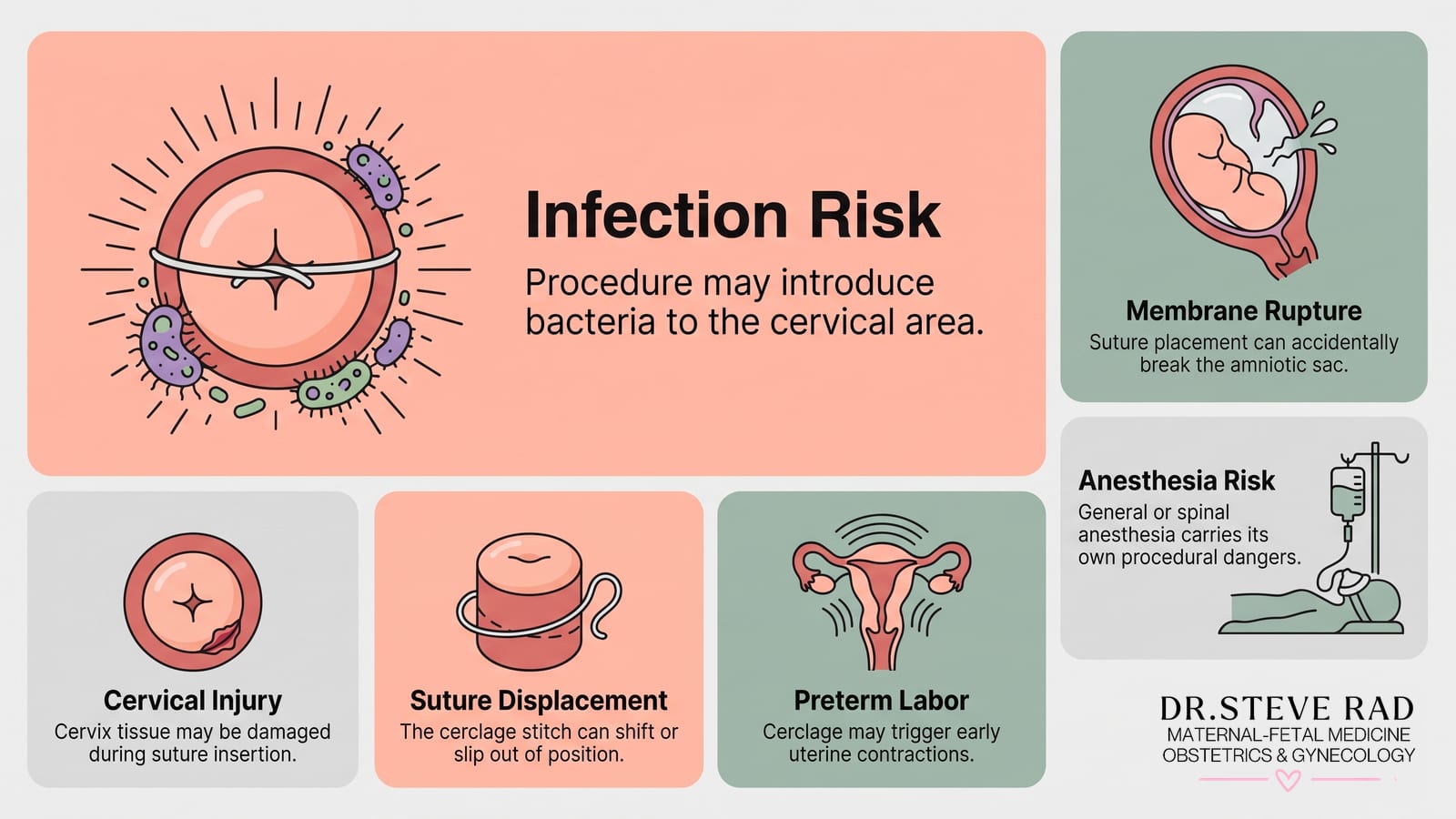
Cervical cerclage is generally considered a safe procedure, and for most patients with cervical insufficiency, the benefits far outweigh the risks. That said, we believe every patient deserves to be fully informed before making any decision about their care – and that’s very much part of the Dr. Rad difference. Here’s an honest look at the potential risks involved.
Infection is one of the more common concerns. Bacteria can enter the uterus during or after the procedure, so your doctor will typically prescribe antibiotics as a precaution. Signs of infection – such as fever, unusual discharge, or pelvic pain – should always be reported to your care team right away.
Premature rupture of membranes (PROM) is another possible complication, where the amniotic sac breaks earlier than expected. This is more likely with an emergency or rescue cerclage placed later in pregnancy, when the cervix may already be dilated.
Cervical laceration or tearing can occur, particularly if labor begins before the stitch is removed. This is one reason why timing the removal – typically around 36 to 37 weeks – is so important.
Cervical scarring. In rare cases, the suture can cause scarring that may affect future cervical dilation during labor.
Displacement of the suture. The cerclage can occasionally shift out of position, reducing its effectiveness.
Anesthesia risks. As with any procedure requiring spinal, epidural, or general anesthesia, there are small associated risks that your anesthesia provider will review with you.
Preterm labor can occasionally be triggered by the procedure itself, especially if there is underlying inflammation or infection such as ureaplasma that wasn’t detected beforehand.
Rare risks include bladder injury and heavy bleeding. Working with an experienced high-risk OB/GYN who specializes in maternal-fetal medicine can significantly reduce these risks and ensure close monitoring throughout your pregnancy.
It is worth keeping these risks in perspective. For women with confirmed cervical insufficiency, the risk of preterm birth or pregnancy loss without intervention is often far greater than the procedural risks of cerclage. Dr. Rad will help you weigh these factors carefully and honestly.
When and How Is a Cervical Cerclage Removed?
One of the most common questions patients ask after a cerclage is placed is, “When does it come out?” The answer depends on the type of cerclage you have and how your pregnancy progresses.
For a transvaginal cerclage – the most common type – removal is typically scheduled around 36 to 37 weeks of pregnancy. At this point, your baby is considered late preterm, and the risk of early delivery is far less concerning than it was earlier in your pregnancy. The good news is that removal is usually a quick, straightforward procedure done right in the office. Most patients find it much less involved than the original placement, and you can generally go home the same day.
If you go into labor before 36 weeks, Dr. Rad may remove the cerclage earlier to allow labor to progress safely. Leaving it in place during active labor can cause cervical tearing, so timing matters. This is one of the many reasons why staying in close contact with your care team throughout your pregnancy is so important – especially if you notice any warning signs like cramping or pressure.
For a transabdominal cerclage (TAC), the situation is a little different. Because the band is placed around the cervix through the abdomen, it cannot be removed vaginally. Instead, you will deliver by cesarean section, and one of the unique advantages of a TAC is that the band can actually be left in place for future pregnancies – something worth discussing with a high-risk OB/GYN who specializes in maternal-fetal medicine.
After cerclage removal, some women go into labor within days, while others continue the pregnancy for several more weeks. Dr. Rad will monitor you closely during this period and discuss what to expect based on your individual situation.
Recovery After Cervical Cerclage
Most women recover well from cervical cerclage, particularly after a transvaginal procedure. Here is what to expect in the hours, days, and weeks that follow:
Immediately after the procedure. Dr. Rad will perform an ultrasound to confirm fetal well-being before you are discharged. You will be monitored for a period in the recovery area until the anesthesia wears off. Most patients go home the same day.
Common short-term symptoms. Spotting, mild cramping, vaginal discharge, and some discomfort with urination are normal for the first few days. Over-the-counter pain relievers such as acetaminophen are generally recommended for discomfort. If Dr. Rad used absorbable sutures to reposition vaginal tissue, you may notice the material passing in two to three weeks as the stitches dissolve, which is completely normal.
Pelvic rest. You will be advised to avoid sexual intercourse for at least a few weeks after the procedure, and in many cases for the remainder of the pregnancy. Dr. Rad will give you specific guidance based on your clinical picture.
Activity restrictions. Most women are advised to avoid heavy lifting, strenuous exercise, and prolonged standing in the days immediately following cerclage. Depending on your situation, Dr. Rad may recommend modified bed rest or reduced activity for a longer period.
Return to work. Many women with desk jobs or low-activity roles can return to work within a few days. Women with physically demanding jobs may need a longer period of modified duties. Discuss your specific work situation with Dr. Rad so he can provide appropriate documentation and guidance.
Follow-up monitoring. You will have scheduled follow-up appointments that typically include transvaginal ultrasound to monitor cervical length and fetal growth. The frequency of these visits depends on your individual risk profile.
Call (844) 473-6100 or click here to schedule online
When to call your doctor after cerclage
Once your cervical cerclage is in place, most women go home the same day and recover comfortably with rest and light activity restrictions. But knowing which symptoms are normal and which ones need immediate attention can make a real difference in your outcome – and your peace of mind.
Some mild spotting, light cramping, and pelvic pressure in the first day or two after the procedure are completely expected. These usually settle down quickly on their own. Watch for symptoms that go beyond that normal window.
Contact Dr. Rad right away if you experience any of the following:
Heavy vaginal bleeding (more than light spotting)
A fever of 100.4°F (38°C) or higher, which could signal infection
Strong or worsening uterine cramping that doesn’t ease with rest
A gush or steady trickle of fluid from the vagina, which may indicate your membranes have ruptured
Unusual or foul-smelling vaginal discharge
Pelvic pressure that feels like the baby is pushing down
Pain or difficulty urinating
These warning signs can point to serious complications like infection, preterm labor, or membrane rupture – all of which require prompt evaluation. Because high-risk pregnancies demand an extra level of vigilance, Dr. Rad offers 24/7 availability so you never have to wonder whether something is serious enough to call about. That is the Dr. Rad difference – you always have a trusted expert in your corner, day or night. When in doubt, reach out. Your baby’s safety is always worth the call.

If you had cervical cerclage because your cervix had already begun to open or an ultrasound showed that your cervix is short, you might need to remain on bedrest in the hospital for observation. As a precaution, your health care provider might recommend limiting physical activity and sex until delivery.
Your health care provider will continue to monitor you closely for signs or symptoms of preterm labor.
More About Dr. Rad
Dr. Rad and his world-class team at the Los Angeles Fetal and Maternal Care Center understand your healthcare needs before, during, and after birth. As a double-board-certified OB/GYN with MFM subspecialty training, Dr. Rad brings specialist-level expertise to every consultation, whether you are coming in for a routine cervical length check or navigating a complex high-risk pregnancy. We provide compassionate, concierge-level care, answer your questions honestly, and offer emotional support so you can navigate your pregnancy with confidence.
Call us at (844) 473-6100 or schedule your consultation online. We are currently accepting new patients.
We are conveniently located for patients throughout Southern California and the Los Angeles area, with locations in or near Beverly Hills, Santa Monica, West Los Angeles, West Hollywood, Culver City, Hollywood, Venice, Marina del Rey, Malibu, Manhattan Beach, Newport Beach, Irvine, and Downtown Los Angeles. We also offer in-home prenatal care and a fly-in program for out-of-town and international patients. Dr. Rad travels to patients who need him throughout the U.S. and around the world, and virtual consultations are available worldwide
Frequently Asked Questions About Cervical Cerclage
How successful is cervical cerclage?
Cervical cerclage is successful in approximately 90% of cases when performed in appropriately selected patients. Success rates are highest for history-indicated and ultrasound-indicated cerclage placed before significant cervical change. Emergency (rescue) cerclage carries a lower but still meaningful success rate, and Dr. Rad will give you an honest assessment of what to expect based on your specific situation.
How long does the cerclage stay in?
For transvaginal cerclage, the suture is typically removed at 36-37 weeks of pregnancy. For transabdominal cerclage, the synthetic band remains in place permanently, and the baby is delivered by C-section.
Can I work after having a cerclage?
Many women with sedentary jobs return to work within a few days. Women with physically demanding roles may need modified duties or a longer recovery period. Dr. Rad will provide personalized guidance and any necessary documentation for your employer.
Are there alternatives to cervical cerclage?
Yes. Depending on your clinical picture, Dr. Rad may discuss progesterone supplementation (vaginal progesterone or 17-OHPC injections) or a cervical pessary as alternatives or complements to cerclage. Each option has a different evidence base and suits different patient profiles. Dr. Rad will explain which approach, or combination of approaches, is most appropriate for you.
Does having a cerclage affect future pregnancies?
A transvaginal cerclage is removed after each pregnancy and can be placed again in a subsequent pregnancy if needed. A transabdominal cerclage band can remain in place for future pregnancies, which is one of its key advantages for women with severe cervical insufficiency.
How is a cerclage different from a cervical pessary?
A cervical pessary is a removable silicone device placed around the cervix to provide mechanical support, without any surgical incision or suture. It is a non-surgical option that some women prefer. Cerclage is a surgical procedure that physically closes the cervix with a suture or band. Dr. Rad will discuss which option best suits your anatomy and history.
Call (844) 473-6100 or click here to schedule online