Severe Pregnancy Vomiting? A Perinatologist Explains Your Treatment Options
You’ve vomited six times before noon, you can’t keep water down, and your OB’s next available appointment is in two weeks.
This isn’t morning sickness, and you shouldn’t manage it alone. Hyperemesis gravidarum (HG) is a distinct clinical condition that can become dangerous without the right intervention, and the standard advice to “eat crackers and rest” simply does not apply.

We understand pregnancy can be a vulnerable and anxious time. If you’re suffering through relentless nausea and vomiting that no amount of ginger tea or crackers can touch, you deserve real answers.
This guide covers the full spectrum of hyperemesis gravidarum treatment, from first-line medications to specialist-managed at-home IV care, how to know when your symptoms cross into high-risk territory, and what a maternal-fetal medicine specialist can do that a general OB cannot.
Specifically, you’ll learn how to distinguish HG from normal nausea of pregnancy, how the treatment ladder works at every stage of severity, and why at-home concierge care is changing the way high-risk patients manage this condition without repeated emergency room visits.
If you’re looking for specialist support right now, you can schedule a consultation with a high-risk pregnancy specialist to create a personalized plan.
Hyperemesis Gravidarum vs. Morning Sickness: Why the Difference Matters for Treatment
Between 70 and 80 percent of pregnant women experience some degree of nausea and vomiting during pregnancy, commonly called morning sickness.
HG is not a more intense version of that experience. It is a separate clinical condition with measurable metabolic consequences that require medical intervention.
The clinical threshold matters: HG is characterized by persistent vomiting more than three to four times daily, loss of five percent or more of pre-pregnancy body weight, and signs of dehydration including dark urine, dizziness, and rapid heart rate.
According to research published in the Archives of Women’s Mental Health by researchers at Northwestern University, HG affects approximately 0.5 to 2 percent of pregnancies and is the leading cause of hospitalization in the first trimester.
Normal pregnancy nausea typically peaks around weeks 8 to 10 and resolves by the end of the first trimester. HG can persist well into the second trimester and, in some cases, throughout the entire pregnancy. That distinction changes everything about how it should be treated.
When Should I Go to the Hospital for Hyperemesis Gravidarum?
HG symptoms go beyond nausea. Patients typically present with persistent vomiting that prevents any oral intake, significant weight loss, ketosis (a metabolic state where the body breaks down fat for energy due to carbohydrate deprivation), electrolyte imbalances affecting sodium, potassium, and magnesium, and in severe untreated cases, a neurological complication called Wernicke’s Encephalopathy caused by thiamine (Vitamin B1) deficiency.
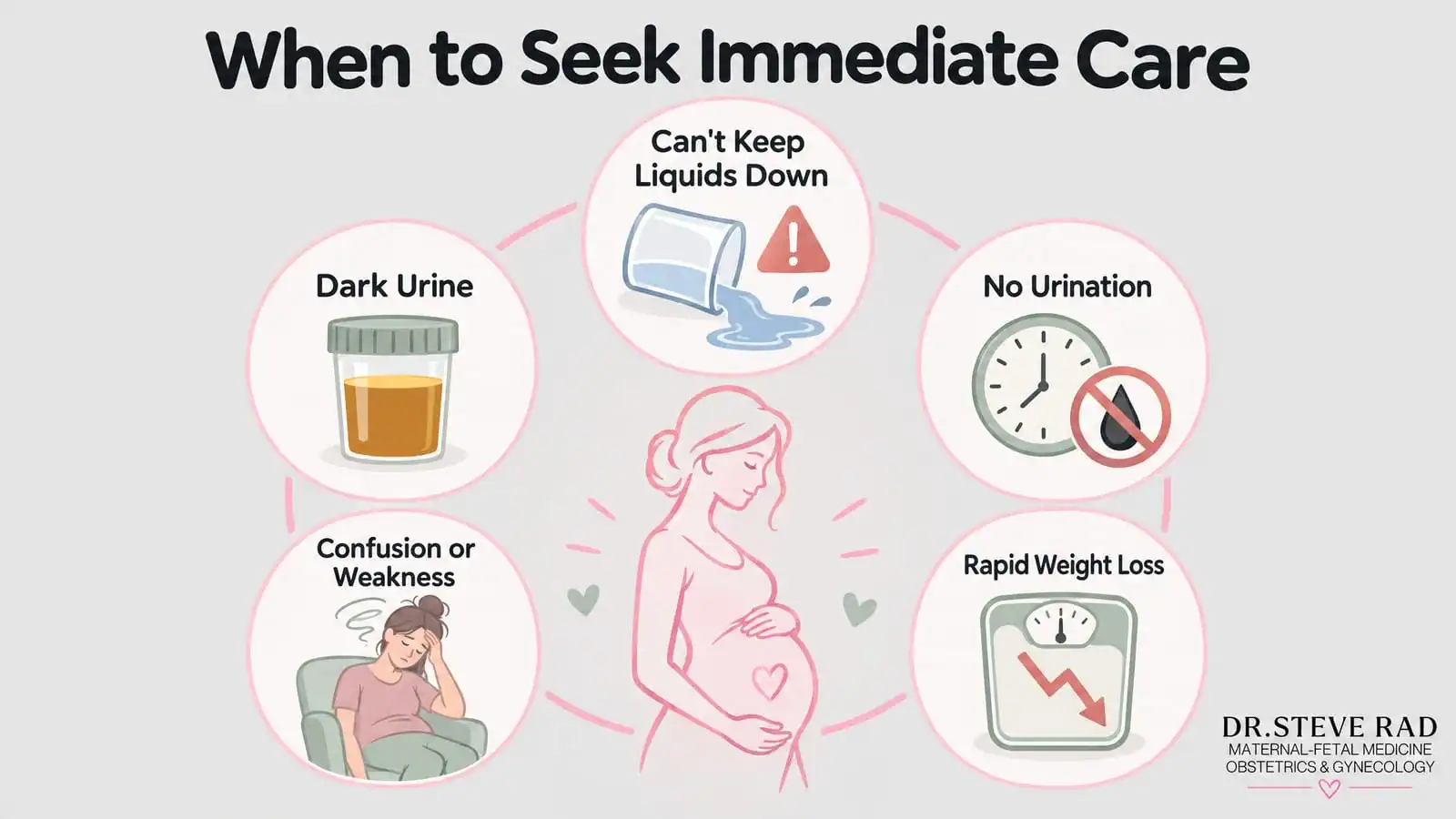
You should seek immediate medical attention if you cannot keep any liquids down for 24 hours, if you notice your urine is dark, or you haven’t urinated in eight or more hours, if you feel confused or extremely weak, or if you’ve lost more than two pounds in a week. Don’t wait out these symptoms.
Braelyn’s story illustrates exactly why early recognition matters. She came to us suffering from severe, unrelenting nausea and vomiting that had taken over her pregnancy and her life.
Many providers had attributed her symptoms to typical morning sickness. Dr. Rad accurately diagnosed her condition as hyperemesis gravidarum and quickly implemented a targeted treatment plan that brought her symptoms under control, allowing her pregnancy to continue safely.
The difference between a correct diagnosis and a dismissed one can be weeks of unnecessary suffering.
What Causes Hyperemesis Gravidarum? Hormones, Genetics, and Risk Factors Explained
The exact cause of HG is not fully understood, but the strongest evidence points to hormonal changes, specifically the rapid rise of human chorionic gonadotropin (hCG) in early pregnancy. hCG levels peak around weeks 8 to 10, which correlates with when HG symptoms are typically most severe.
Women carrying multiples, who have significantly higher hCG levels, are at elevated risk.
Genetics also plays a meaningful role. Women with a mother or sister who experienced HG are significantly more likely to develop it themselves. A personal history of HG in a prior pregnancy is one of the strongest individual risk factors.
Other contributing factors include a history of conditions that affect gastrointestinal motility, such as migraine disorders, and nutritional deficiencies entering pregnancy.
Risk factors that increase the likelihood of HG include: first pregnancy, multiple gestation (twins or more), prior history of HG, history of motion sickness or migraine, and certain thyroid conditions.
Identifying these risk factors early allows a specialist to monitor more closely and intervene before symptoms become severe, which is central to how we approach care for high-risk pregnancy conditions managed by a maternal-fetal medicine specialist.
Call (844) 473-6100 or click here to schedule online
The Full Hyperemesis Gravidarum Treatment Ladder: From Dietary Changes to IV Fluids
What is the most effective treatment for hyperemesis gravidarum?
HG treatment follows a stepwise escalation based on symptom severity. No single treatment works for every patient, so the most effective approach is personalized, monitored, and adjusted as the pregnancy progresses. Here is how the treatment ladder works in practice.
Step one: Dietary and lifestyle modifications. For mild to moderate symptoms, small frequent meals, avoiding triggers, eating before getting out of bed, and separating liquids from solids can reduce vomiting frequency.
Cold foods are often better tolerated than hot ones because they produce less odor. Prenatal vitamins, which can worsen nausea, may need to be temporarily switched to a gummy formulation or taken at a different time of day.
Step two: Oral rehydration and electrolyte support. When dietary changes are insufficient, oral rehydration solutions that replace sodium, potassium, and magnesium can help stabilize electrolyte imbalances before they become dangerous. This step is often combined with first-line medications.
Step three: Prescription anti-nausea medications. When oral intake remains compromised, we introduce medications. We cover the specific agents in the next section.
Step four: IV hydration and nutritional support. When oral medications and fluids cannot be maintained, intravenous hydration becomes necessary. This is the step where most patients end up in the emergency room, often repeatedly.
But it does not have to work that way. A qualified specialist can deliver IV hydration at home, which we return to in detail below.
Step five: Specialist-managed inpatient or continuous home care. For patients with severe, refractory HG or those with co-occurring high-risk conditions, a maternal-fetal medicine specialist takes over ongoing management, which may include PICC line placement for extended nutritional support.
Medications Used to Treat HG: What’s Safe, What Works, and What Comes Next
What medications are safe for hyperemesis gravidarum during pregnancy?
The first-line pharmacologic treatment for HG, as supported by research published in the National Institutes of Health clinical literature, is a combination of doxylamine and Vitamin B6 (pyridoxine).
This combination is FDA-approved for nausea and vomiting of pregnancy and is generally the starting point when dietary measures fail.
When doxylamine and B6 are insufficient, clinicians typically add promethazine (an antihistamine with antiemetic properties) and ondansetron, commonly known by the brand name Zofran. Ondansetron blocks serotonin receptors in the gut and brain that trigger the vomiting reflex.
It is widely used in HG management and is generally considered safe in the second and third trimesters, though its use in the first trimester is discussed on a case-by-case basis with the treating physician.
For patients who do not respond to these agents, corticosteroids such as methylprednisolone have been used in refractory cases, though they carry their own risk profile and are typically reserved for severe, hospitalization-level HG. The key point is that medication selection must be individualized.
What works for one patient may be ineffective or poorly tolerated by another, which is why ongoing specialist oversight matters far more than a one-size-fits-all prescription.
When Standard OB Care Isn’t Enough: The Role of a Maternal-Fetal Medicine Specialist
Do I need a specialist for hyperemesis gravidarum?
Most patients with mild to moderate HG can be managed by a general OB-GYN. But some patients need more than standard OB care, and recognizing that threshold early can prevent serious complications.
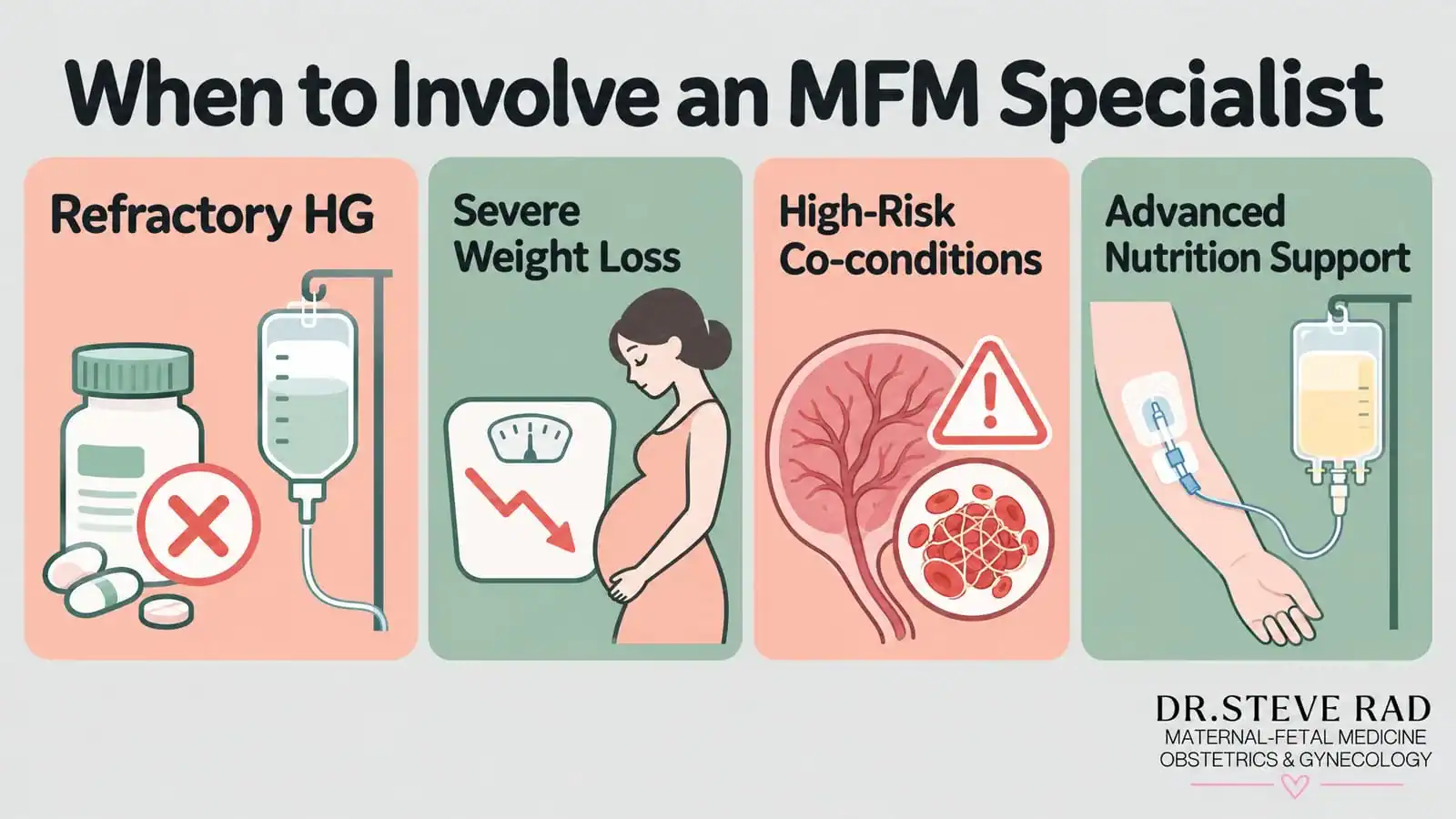
A maternal-fetal medicine (MFM) specialist, also called a perinatologist, should be involved when HG is refractory to first- and second-line treatments, when the patient has lost more than ten percent of pre-pregnancy body weight, when HG co-occurs with other high-risk conditions such as a blood clotting disorder or placental complications, or when the patient requires PICC line placement or total parenteral nutrition (TPN).
Consider Jennifer’s case. She came to us with what appeared to be severe pregnancy nausea, but Dr. Rad identified that her symptoms were compounded by a blood clotting disorder and marginal cord insertion, two conditions that a general OB might not have connected to her presentation.
His timely diagnosis led to life-saving treatment with blood thinners alongside her HG management, enabling a successful pregnancy outcome. This layered clinical thinking is what a maternal-fetal medicine specialist brings to a case that a standard OB visit simply cannot replicate.
If you’re navigating a pregnancy where HG is one of several concerns, Dr. Steve Rad, a Los Angeles maternal-fetal medicine specialist, outlines the full scope of his training and clinical expertise, including his fellowship at Cedars-Sinai Medical Center and his faculty appointments at UCLA and UCSF.
At-Home and Concierge HG Treatment: An Alternative to Repeated ER Visits
Can hyperemesis gravidarum be treated at home?
Yes, and for many patients, at-home treatment is not just possible but preferable. The emergency room model of HG management, where a patient drives herself to the ER while vomiting, waits hours for a bed, receives a single IV bag, and is discharged with no follow-up plan, is reactive, exhausting, and often inadequate. It treats the crisis without addressing the underlying pattern.
IV hydration, the primary intervention for moderate to severe HG, can be delivered at home by a qualified provider. A home IV infusion restores blood volume, corrects electrolyte imbalances, and can include anti-nausea medications and thiamine supplementation to prevent Wernicke’s Encephalopathy, all in the comfort and safety of the patient’s own environment.
Patients typically begin feeling relief within the first 30 to 60 minutes of infusion.
At Dr. Rad’s practice, we offer at-home prenatal care including IV hydration and 24/7 monitoring as a core part of our concierge model. This means a patient experiencing a severe HG episode at 2 a.m. does not have to choose between suffering through the night and sitting in an emergency room. We come to her. That is the Dr. Rad difference.
Call (844) 473-6100 or click here to schedule online
The concierge model also provides continuity the ER cannot. When the same specialist manages your care across multiple visits, they track your weight, your hydration status, your medication response, and your baby’s growth in a coordinated way.
For patients whose HG persists into the second trimester or beyond, this continuity is not a luxury. It is a clinical necessity.
Rebecca Lu traveled from China specifically to access this level of care for her 2023 pregnancy. She sought out Dr. Rad’s expertise because she wanted a provider who would be genuinely present throughout her pregnancy, not just available for scheduled appointments.
That kind of trust-based, continuous relationship is what the concierge model is built on, and it is particularly valuable for patients managing a condition as unpredictable and exhausting as HG.
For patients in Los Angeles and the surrounding Southern California area, this model is accessible. Office visits, telemedicine consultations, home visits, and travel visits are all available, 24 hours a day, seven days a week. You should not have to manage hyperemesis gravidarum alone between appointments.
What to Expect After Treatment: Recovery, Nutrition, and Monitoring Your Baby’s Growth
Does hyperemesis gravidarum go away on its own?
For most patients, HG symptoms improve significantly by weeks 14 to 20 of pregnancy, though a meaningful percentage of women experience symptoms throughout the entire pregnancy.
HG does not simply resolve on its own without treatment in moderate to severe cases. Untreated, it can lead to dangerous nutritional deficiencies, fetal growth restriction, and in extreme cases, maternal complications requiring hospitalization for weeks.
Can hyperemesis gravidarum harm my baby?
When HG is properly treated and the mother maintains adequate nutrition and hydration, outcomes for the baby are generally good. The concern arises when HG goes undertreated, and the mother experiences prolonged weight loss and nutritional deficiencies.
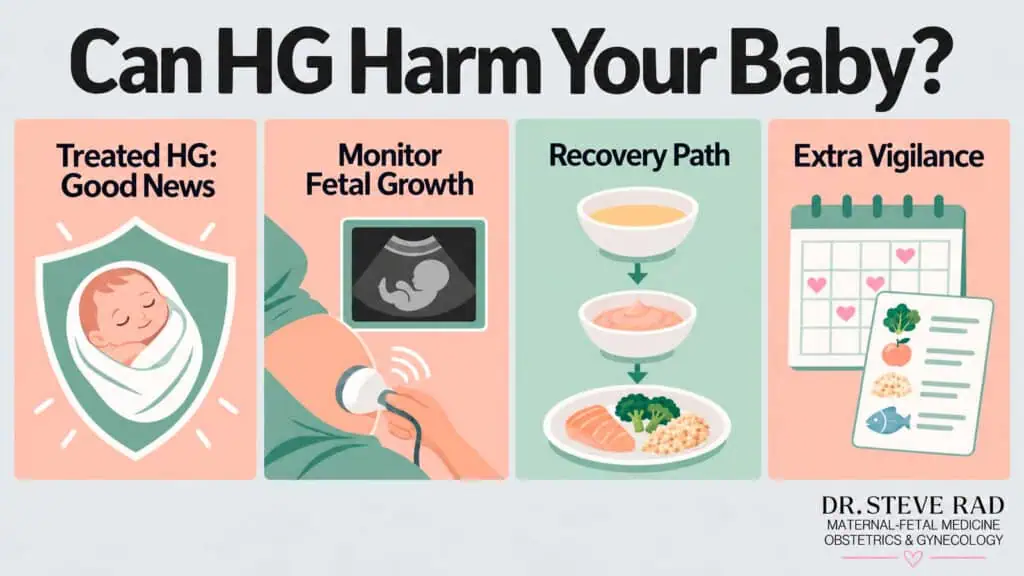
In those cases, there is an increased risk of intrauterine growth restriction (IUGR), low birth weight, and preterm birth. This is precisely why monitoring fetal growth alongside maternal treatment is essential, not optional.
After the acute phase of HG is controlled, recovery focuses on gradual reintroduction of foods, rebuilding nutritional stores, and close monitoring of fetal growth through regular ultrasound.
Patients who have experienced significant weight loss during HG may need targeted nutritional counseling and more frequent growth scans to ensure the baby is developing on track.
Zoe Sara Haklili’s experience is a powerful example of what proactive monitoring achieves. She selected Dr. Rad as her OB-GYN before any complications arose. When intrauterine growth restriction concerns developed during her pregnancy, the monitoring infrastructure was already in place.
Because her care was continuous and specialist-led from the start, Dr. Rad intervened early and guided her to a healthy, full-term delivery. That outcome is not guaranteed without the right level of oversight.
Recovery also includes attention to mental health. HG carries a significant psychological burden. Patients describe feeling isolated, dismissed, and frightened, particularly when their symptoms are minimized by providers or family members who mistake HG for ordinary morning sickness.
A care model that acknowledges this burden, provides consistent access to a trusted specialist, and treats the whole patient rather than just the vomiting episode makes a measurable difference in how women experience and recover from this condition. We treat all patients as VIPs, ensuring you feel cared for and supported through every stage of your pregnancy.
If you are currently experiencing symptoms that sound like HG, or if you have been diagnosed and feel your current care plan is not working, the right next step is a specialist consultation.
Explore the full range of high-risk pregnancy conditions managed by a maternal-fetal medicine specialist to understand what specialist care covers, then reach out to schedule a personalized evaluation.

Call (844) 473-6100 or click here to schedule online
Frequently Asked Questions
What is the most effective treatment for hyperemesis gravidarum?
What is the most effective treatment for hyperemesis gravidarum?
No single treatment is most effective because HG severity varies widely between patients. The most effective approach is a personalized, escalating treatment plan that begins with dietary modifications and oral rehydration, advances to prescription anti-nausea medications such as doxylamine plus Vitamin B6 or ondansetron, and escalates to IV hydration when oral intake cannot be maintained. For patients with severe or refractory HG, specialist-managed care including at-home IV therapy or PICC line placement provides the most consistent relief and the best outcomes for both mother and baby.
What medications are safe for hyperemesis gravidarum during pregnancy?
The FDA-approved first-line medication for nausea and vomiting of pregnancy is the combination of doxylamine and pyridoxine (Vitamin B6), sold under the brand name Diclegis or Bonjesta. When this is insufficient, promethazine and ondansetron (Zofran) are commonly used under physician supervision. Corticosteroids are reserved for severe, treatment-resistant cases. Make all medication decisions during pregnancy with your OB-GYN or maternal-fetal medicine specialist, who can weigh the risks and benefits based on your gestational age and medical history.
When should I go to the hospital for hyperemesis gravidarum?
Go to the hospital or contact your provider immediately if you cannot keep any liquid down for 24 hours, if you have not urinated in eight or more hours or your urine is very dark, if you feel faint, confused, or extremely weak, or if you have lost more than two pounds in a week. These signs indicate dehydration and electrolyte imbalance that require IV intervention. If you have access to a concierge provider who offers home visits, that may be a faster and less stressful alternative to the emergency room for IV hydration.
Does hyperemesis gravidarum go away on its own?
Mild HG may improve as hCG levels stabilize after the first trimester, typically around weeks 14 to 20. However, moderate to severe HG does not resolve safely without medical treatment. Approximately 20 percent of women with HG experience symptoms throughout their entire pregnancy. Waiting for HG to resolve on its own without intervention risks dangerous dehydration, nutritional deficiencies including thiamine deficiency that can cause neurological damage, and fetal growth complications. Early, proactive treatment consistently produces better outcomes than a wait-and-see approach.
Can hyperemesis gravidarum harm my baby?
When HG is properly diagnosed and treated, the vast majority of babies are born healthy with no long-term complications. The risk to the baby increases when HG goes undertreated, and the mother experiences prolonged weight loss, severe dehydration, and nutritional deficiencies. In those cases, risks include intrauterine growth restriction, low birth weight, and preterm birth. Regular fetal growth monitoring through ultrasound is an essential part of HG management, not an add-on, and should be coordinated with your treating specialist throughout the pregnancy.

Written by Dr. Rad Education Team

Medically Reviewed by Dr. Steve Rad