You’ve just seen two pink lines again – and instead of pure joy, your first feeling is fear. If you’ve experienced a miscarriage, that reaction is not only understandable; it’s one of the most common things Dr. Rad hears from patients walking through his door. We understand that pregnancy after loss can feel like walking a tightrope, and you deserve more than reassurance – you deserve a clear clinical picture.

This article explains exactly when a pregnancy after miscarriage is considered high-risk, which underlying conditions require specialist monitoring, and what a truly supported subsequent pregnancy looks like under the care of a maternal-fetal medicine specialist. Specifically, you’ll learn: the clinical criteria that formally elevate your risk, the tests and early scans that can catch problems before they escalate, and what specialist-level monitoring actually looks like week by week.
If you’re already pregnant again and wondering whether your history warrants more than standard OB care, schedule a consultation with a maternal-fetal medicine specialist to get a personalized assessment.
Does a history of miscarriage automatically make your next pregnancy high-risk?
The short answer is: not always, but more often than most patients are told. A single miscarriage – which affects approximately 10-15% of known pregnancies according to Mayo Clinic – does not automatically classify your next pregnancy as high-risk in the formal clinical sense. Most women who experience one miscarriage go on to have uncomplicated subsequent pregnancies.
However, “not automatically high-risk” is not the same as “no additional monitoring needed.” A prior loss changes the clinical picture in ways that a standard prenatal intake form doesn’t fully capture. The key question isn’t just how many miscarriages you’ve had – it’s whether that loss revealed an underlying condition that will affect future pregnancies.
Are you considered high risk after a miscarriage?
Whether you’re formally classified as high-risk depends on what caused the miscarriage and what your full medical history looks like. A single first-trimester loss caused by a random chromosomal abnormality – which accounts for 50-80% of early pregnancy losses – typically does not place you in a high-risk category on its own. But if your miscarriage was associated with a structural uterine issue, a blood clotting disorder, thyroid dysfunction, or poorly controlled diabetes, your next pregnancy requires specialist co-management from the start.
How many miscarriages does it take to be considered high risk?
Two or more consecutive pregnancy losses meet the clinical threshold for recurrent pregnancy loss, which is a formal high-risk designation requiring investigation. After two miscarriages, the risk of a third rises to approximately 25-30%. After three or more, that risk climbs further, and the likelihood of an identifiable underlying cause increases significantly. At that point, a maternal-fetal medicine specialist should be involved in both the pre-conception workup and the subsequent pregnancy.
The hidden conditions a miscarriage can reveal – and why they matter for your next pregnancy
One of the most important things a miscarriage can do – as painful as this is to frame – is surface a condition that was silently affecting your reproductive health. Many of the conditions that cause pregnancy loss are entirely treatable once identified. The problem is that they’re rarely investigated after a single loss, and sometimes not even after two.
The conditions most commonly linked to pregnancy loss and elevated risk in subsequent pregnancies include:
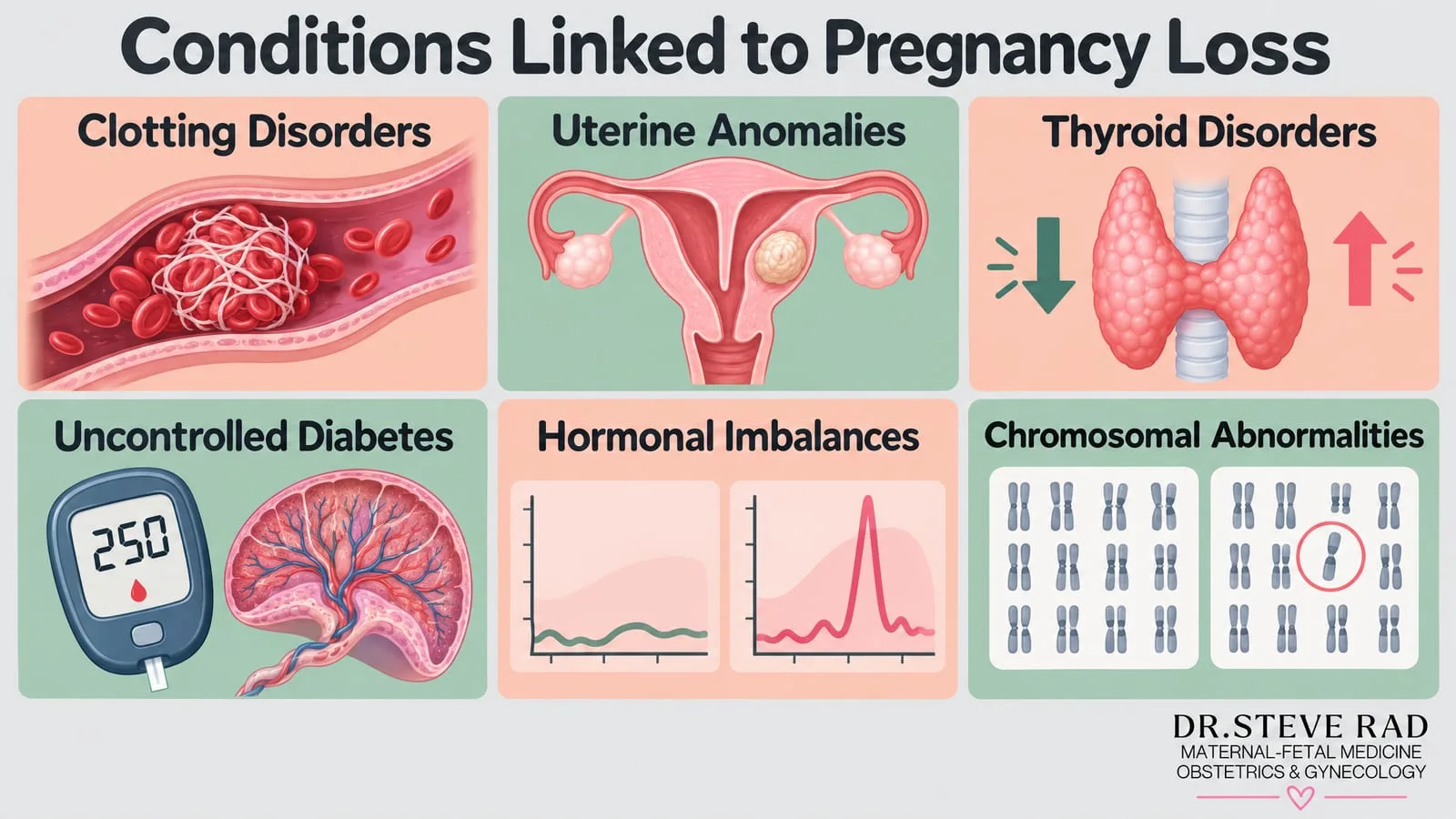
Blood clotting disorders, particularly antiphospholipid syndrome (APS), which causes the immune system to produce antibodies that increase clot formation in placental blood vessels
Uterine anomalies, including a septate uterus, fibroids, or intrauterine adhesions (Asherman’s syndrome) that interfere with implantation or fetal growth
Thyroid disorders, both hypothyroidism and hyperthyroidism, which disrupt the hormonal environment needed to sustain early pregnancy
Uncontrolled diabetes, which increases the risk of chromosomal abnormalities and placental dysfunction
Hormonal imbalances, including luteal phase deficiency and elevated prolactin levels
Chromosomal abnormalities in one or both parents, which can be identified through parental karyotyping
Jennifer’s case illustrates exactly why this investigation matters. She came to us with what appeared to be a straightforward pregnancy, but Dr. Rad identified a blood clotting disorder combined with marginal cord insertion – a combination that, left undetected, could have been life-threatening. Timely diagnosis led to treatment with blood thinners, and Jennifer went on to have a successful pregnancy outcome. That kind of early identification is only possible when a specialist is actively looking for it.
Call (844) 473-6100 or click here to schedule online
Recurrent pregnancy loss: when one miscarriage becomes a pattern that needs investigation
Recurrent pregnancy loss (RPL) is defined as two or more clinical pregnancy losses, and it affects approximately 1-2% of couples trying to conceive. Despite how common it is, many patients are told to “just try again” after their second loss without any formal workup. That advice is outdated and, in our experience, deeply frustrating for patients who deserve answers.
A proper RPL evaluation includes a panel of tests designed to identify the treatable causes listed above. This typically involves a thrombophilia panel to screen for clotting disorders like antiphospholipid syndrome, thyroid function tests, a pelvic ultrasound or hysteroscopy to assess uterine structure, and parental chromosomal analysis. According to research published in PubMed Central, the interpregnancy interval and underlying maternal factors both significantly influence the risk of subsequent loss – which is why the timing of investigation matters as much as the investigation itself.
Shanley’s story is one we return to often when patients feel hopeless after multiple losses. She had a heartbreaking history of placental abruption, a condition that put any future pregnancy at serious risk. With specialized monitoring and support through our practice, she conceived again and carried her second pregnancy to a healthy delivery. Placental abruption recurrence risk is real, but manageable with the right level of surveillance.
For a full overview of the high-risk pregnancy conditions we diagnose and manage, including recurrent pregnancy loss, our conditions page outlines what each diagnosis means for your care plan.
What a maternal-fetal medicine specialist does differently in a pregnancy after loss
A general OB/GYN provides excellent care for most pregnancies. But a maternal-fetal medicine (MFM) specialist – also called a perinatologist – brings a different level of diagnostic precision and monitoring intensity to pregnancies that carry elevated risk. The distinction matters most in the first trimester, when the conditions most likely to cause loss are also most detectable.
At Dr. Rad’s practice, a pregnancy after miscarriage is never treated as routine. The first difference is access: patients have 24/7 availability with office, telemedicine, home, and travel visit options, which means a concern at 2 a.m. doesn’t have to wait until Monday morning. The second difference is technology. We use GE 3D/4D high-definition ultrasound – available in only a few places in the world – which allows us to visualize fetal anatomy and placental structure with a level of detail that standard 2D ultrasound simply cannot match.
The third difference is the pre-conception conversation. Before a patient with a history of miscarriage attempts another pregnancy, we want to sit down and review everything: prior pregnancy records, any testing that was or wasn’t done, current thyroid and clotting status, and uterine anatomy. That conversation shapes the entire monitoring plan for the pregnancy that follows.
Early monitoring and testing: what to expect in a high-risk pregnancy after miscarriage
This is the section that most articles skip entirely – and it’s the one patients need most. What does specialist monitoring actually look like, week by week, in a pregnancy after loss?
What tests should I have before getting pregnant again after a miscarriage?
Before attempting another pregnancy, we recommend a pre-conception panel that includes: a complete thrombophilia screen (antiphospholipid antibodies, Factor V Leiden, prothrombin gene mutation), thyroid function tests (TSH, free T4), a pelvic ultrasound to assess uterine anatomy, and – if two or more losses have occurred – parental karyotyping. If diabetes is a concern, a fasting glucose and HbA1c provide a baseline. These tests remove the guesswork for the next pregnancy and allow us to intervene before problems develop rather than after.
What monitoring is recommended during pregnancy after a miscarriage?
Once pregnant, the monitoring schedule for a high-risk patient is meaningfully different from standard prenatal care. Early in the first trimester, we typically schedule viability scans at 6-8 weeks to confirm cardiac activity and appropriate growth. Between 11 and 16 weeks, our early fetal ultrasound scans using GE 3D/4D technology allow us to assess fetal anatomy, nuchal translucency, and early placental positioning with exceptional clarity – far earlier than most practices offer this level of detail.
For patients with a history of cardiac concerns or those carrying a fetus at elevated risk for structural heart defects, a fetal echocardiogram between 20 and 24 weeks provides a detailed assessment of fetal cardiac anatomy. Prenatal genetic testing – including cell-free DNA (cfDNA) screening and, where indicated, chorionic villus sampling (CVS) or amniocentesis – is discussed and offered based on individual risk factors and patient preference.
Zoe’s experience captures why this early monitoring matters so much. She selected Dr. Rad as her OB/GYN before any complications arose, and when intrauterine growth restriction (IUGR) concerns developed during her pregnancy, the monitoring infrastructure was already in place. Because we were watching closely, we caught the growth restriction early, managed it proactively, and Zoe carried her baby to full term. That outcome is not guaranteed – but it is far more likely when surveillance is built into the care plan from the beginning.
Managing anxiety and uncertainty: how 24/7 specialist access changes the experience
The clinical side of pregnancy after miscarriage is only part of the picture. The emotional experience of a subsequent pregnancy after loss is its own challenge – one that standard prenatal care is not designed to address. Anxiety in pregnancy after loss is not irrational. It is a reasonable response to a real experience, and it deserves a care model that takes it seriously.
What we’ve found at our practice is that anxiety is most acute in the gaps between appointments. When a patient can’t feel movement yet, when a symptom appears at night, when a scan is days away – those are the moments that feel unbearable after a loss. Our concierge VIP care model closes those gaps. Patients can reach us at any hour, through any channel, and receive a response from someone who knows their history and their case.
This isn’t a luxury add-on. For patients managing a high-risk pregnancy after miscarriage, 24/7 access to a specialist is a clinical tool. Early symptom reporting leads to earlier intervention. Earlier intervention leads to better outcomes. That is the Dr. Rad difference.
Our at-home prenatal care option extends this further – for patients who are on bed rest, managing severe symptoms like hyperemesis gravidarum, or simply unable to travel, we bring specialist-level care directly to them. Braelyn, who suffered from severe, unrelenting morning sickness later diagnosed as hyperemesis gravidarum, received exactly this kind of responsive, in-person care that brought her symptoms under control and allowed her pregnancy to continue safely.
When to see a perinatologist after a miscarriage – and what that first consultation looks like
The clearest answer to “when should I see a maternal-fetal medicine specialist?” is: before your next pregnancy, if possible. A pre-conception consultation with a perinatologist lets you identify and address risk factors before they affect another pregnancy. If you’re already pregnant, the right time to seek an MFM referral is now – not after a problem develops.
When should I see a maternal-fetal medicine specialist after a miscarriage?
You should seek an MFM consultation after a miscarriage if: you’ve had two or more pregnancy losses, your miscarriage occurred after 10 weeks of gestation, you have a known or suspected clotting disorder, thyroid condition, or uterine anomaly, you are over 35, or your current pregnancy has already been flagged as high-risk by your OB/GYN. You don’t need a referral to contact our practice directly – many patients come to us independently after researching their options.
At that first consultation, we review your complete obstetric and medical history, order any outstanding pre-conception or early pregnancy labs, perform an early ultrasound assessment if you’re already pregnant, and build a personalized monitoring plan. Nothing is assumed. Everything is tailored to your specific history and risk profile.
Dr. Rad has been selected by peers as Los Angeles’ best Maternal/Fetal specialist six years in a row in LA Magazine, trained at the David Geffen School of Medicine at UCLA, and completed his MFM fellowship at Cedars-Sinai Medical Center. That depth of training and recognition exists to serve patients at exactly this kind of crossroads – when the stakes are highest, and the need for precision is greatest.
If you’re navigating a pregnancy after miscarriage and want specialist-level care from the start, book a consultation with Dr. Rad to discuss your history and build a monitoring plan designed around your specific needs.

Call (844) 473-6100 or click here to schedule online
Pregnancy after miscarriage FAQs
Can a blood clotting disorder cause miscarriage?
Yes, and it’s one of the most underdiagnosed causes of recurrent pregnancy loss. Antiphospholipid syndrome (APS) causes the immune system to produce antibodies that promote abnormal clotting in the placental blood vessels, restricting blood flow to the embryo and increasing the risk of early and late pregnancy loss. The good news is that APS is treatable: low-dose aspirin and low-molecular-weight heparin (a blood thinner) significantly reduce the risk of pregnancy loss in women with confirmed APS. Testing for clotting disorders should be part of any recurrent pregnancy loss workup.
How soon after a miscarriage can I get pregnant again safely?
Current evidence, including research published in PubMed Central, suggests that conceiving within the first three to six months after a miscarriage does not increase the risk of another loss – and may actually be associated with a lower risk of recurrence compared to waiting longer. The Tommy’s pregnancy charity notes there is evidence that conceiving within six months of a loss may lower subsequent miscarriage risk. Physically, ovulation can return as early as two weeks after a miscarriage. The more important question is whether any underlying conditions have been identified and addressed before the next attempt at conception.
What is recurrent pregnancy loss and when is it diagnosed?
Recurrent pregnancy loss (RPL) is formally defined as two or more clinical pregnancy losses before 20 weeks of gestation. It affects approximately 1-2% of couples and warrants a structured diagnostic workup to identify treatable causes. The American College of Obstetricians and Gynecologists (ACOG) recommends evaluation after two consecutive losses, though many MFM specialists – including our practice – will begin a targeted workup after a second loss even if the losses were not consecutive, particularly when the patient is over 35 or has other risk factors.