Difficulty falling or staying asleep is called insomnia. While insomnia can strike at any time, pregnant individuals may be particularly susceptible. Insomnia during pregnancy can start as early as conception and continue into the postpartum period, affecting an estimated 38 to 60 percent of pregnant people at some point across all three trimesters.
There can be many causes of insomnia during this time, often related to emotional, physical, behavioral, or hormonal changes that are normal parts of pregnancy. However, insomnia during pregnancy could also indicate a medical problem that deserves proper evaluation and care.
Whatever the reason, not getting a good night’s sleep during pregnancy can be physically and emotionally exhausting. We understand pregnancy can be a vulnerable and anxious time, and you deserve answers. Let’s take a closer look at pregnancy insomnia, including why it happens, how it is diagnosed, and what you can do about it.

Is insomnia an early sign of pregnancy?
Insomnia in early pregnancy can be somewhat common, with around 13% of expectant parents having difficulty sleeping during the first trimester. Even the American Pregnancy Association calls it normal to experience insomnia during pregnancy.
However, lying awake at night isn’t a reliable sign of pregnancy if you’re trying to conceive. If you’re experiencing insomnia before your period, pregnancy isn’t assured; you may just be nervous or excited about the possibility of conceiving, or you may be feeling the effects of hormonal changes consistent with your menstrual cycle.
Is insomnia before my period a sign of pregnancy?
This is one of the most common questions we hear, and it’s completely understandable. In the days before your period, progesterone rises and then falls sharply if you haven’t conceived. That hormonal shift can disrupt sleep on its own, independent of pregnancy. Anxiety about whether you might be pregnant can also keep your mind racing at night.
If your period is late and you’re experiencing insomnia alongside other early pregnancy symptoms, a home pregnancy test is the most reliable next step. If the result is positive, reach out to our team so we can support you from the very beginning.
What causes insomnia during early pregnancy?
When it comes to confirmed early pregnancy insomnia, progesterone and estrogen – the most well-known pregnancy hormones – may be to blame. These hormonal changes can trigger insomnia in very early pregnancy and continue to cause difficulties as the pregnancy progresses.
As your baby develops, your hormones will continue to change your body. You might find yourself going to the bathroom more often or experiencing nausea and vomiting, both of which can keep you from catching precious Zs.
Sometimes, you may experience behavioral and emotional side effects of pregnancy that can throw off your sleep. You might be excited and anxious, which can affect your sleeping habits. Your normal routine will probably change too as you start avoiding your nightly glass of wine or cutting back on caffeine. Either adjustment can affect your sleep habits.
Hormonal changes can trigger insomnia in very early pregnancy and continue to cause difficulties as the pregnancy progresses.
Can pregnancy cause insomnia in the second trimester and beyond?
Unfortunately, as you enter the second and third trimesters, your insomnia may not ease up and could actually get worse as the physical discomfort and emotional fluctuations of pregnancy increase.
One study found that over 60% of pregnant patients reported insomnia in their third trimester, likely because a slew of pregnancy symptoms can accompany the frequent urination and upset stomach felt in the first trimester. These include:
Leg cramps
Changes in sleeping position
Back pain
Fetal movement
Shortness of breath while lying down
What else can cause insomnia during pregnancy?
If you’re pregnant and can’t sleep, it could also be the result of a medical condition related to or made worse by being pregnant. Beyond the physical discomforts above, several distinct conditions can contribute.
Restless leg syndrome
While it may sound like a made-up condition, restless leg syndrome (RLS) is very real and can be very frustrating. With RLS, you’ll experience tingling, crawling, or creeping sensations in your legs, making you feel like you have to move them. About 15% of Americans experience RLS during pregnancy. Iron deficiency and folate deficiency, both more common in pregnancy, can worsen RLS symptoms, so your provider may check your levels as part of a workup.
Gastroesophageal reflux disease (GERD)
Pregnancy can trigger or exacerbate gastroesophageal reflux disease (GERD). This condition is characterized by chest pain, nausea, heartburn, and hoarseness as stomach acid rises into your esophagus. Various pregnancy changes, like an expanding fetus pressing on your organs, low muscle tone affecting the sphincters that keep digestive acid in your stomach, and diet changes, make GERD a relatively common pregnancy side effect. Sleeping on your left side and elevating the head of your bed can significantly reduce nighttime reflux.
Nightmares
While not technically a medical condition, pregnancy can result in increased frequency and intensity of nightmares. Researchers found that intense and disturbing nightmares may increase in frequency during the third trimester, affecting as many as 50% of pregnant people. The increased stress and anxiety of your pregnancy, upcoming delivery, and life as a new parent can trigger nightmares and poor sleep quality.
Obstructive sleep apnea
Obstructive sleep apnea (OSA) is a sleep-related breathing disorder in which the airway repeatedly collapses during sleep, causing a person to stop breathing, gasp for air, or snore loudly. Weight gain, nasal congestion, and fluid retention during pregnancy all increase the risk of developing OSA. When breathing is interrupted, oxygen desaturation occurs, meaning less oxygen reaches both you and your baby. OSA during pregnancy has been linked to gestational diabetes, preeclampsia, and poor fetal outcomes. If your partner notices you snoring heavily or gasping at night, tell your provider promptly.
Anxiety disorders and perinatal mood disorders
Anxiety disorders are among the most common perinatal mood disorders and a frequently overlooked driver of pregnancy insomnia. Racing thoughts, worry about the baby’s health, fear of childbirth, and general perinatal anxiety can make it nearly impossible to fall or stay asleep. Depression during pregnancy can also disrupt sleep architecture, causing early-morning waking or hypersomnia. If you suspect your sleeplessness has an emotional root, please know it’s valid, treatable, and something Dr. Rad’s team takes seriously. You are not alone.
Is insomnia in late pregnancy a sign of labor?
Those nearing their due date may wonder whether their inability to sleep signals impending labor. Sleep problems before labor are quite common, but they aren’t a definitive sign that your little one is about to make their debut. Instead, the hormonal fluctuations and physical discomfort you’ve been experiencing are likely peaking, making it hard to sleep. True labor is signaled by regular, progressively stronger contractions, not by sleeplessness alone. That said, if you’re unsure or anxious, our team is available 24/7 and always happy to talk you through what you’re experiencing.

Call (844) 473-6100 or click here to schedule online
Is too little sleep while pregnant bad?
Quality, regular sleep is vital for your body to function properly. Adults need seven to eight hours of sleep per night, and that need increases during pregnancy. Perinatal insomnia that isn’t well controlled does come with real, documented risks for both you and your baby.
During pregnancy, you may have a higher chance of developing obstructive sleep apnea. Obstructive sleep apnea (OSA) is a condition in which the soft tissues of the throat relax and partially or fully block the airway during sleep, causing repeated pauses in breathing – sometimes dozens of times per hour. Pregnancy increases OSA risk because weight gain, fluid retention, and hormonal changes all cause the upper airway to narrow. Many pregnant women don’t realize they have it; a bed partner noticing loud snoring or gasping is often the first clue.
If OSA is suspected, your provider may refer you for a sleep study – either an in-lab polysomnography or a home sleep apnea test – to confirm the diagnosis and measure how severely your oxygen levels are dropping overnight. When breathing is repeatedly interrupted during sleep, oxygen desaturation reduces the blood flow and oxygen reaching your baby. This can contribute to intrauterine growth restriction (IUGR), a condition in which the baby does not grow at the expected rate inside the womb, sometimes resulting in a low-birth-weight newborn who needs additional monitoring and care after delivery.
Beyond IUGR, research has linked poor sleep during pregnancy to an increased risk of gestational diabetes and preeclampsia, a serious blood pressure condition that can threaten both mother and baby. Sleep deprivation also weakens immune function and increases inflammation, compounding the physical demands pregnancy already places on your body.

Insomnia may also increase your risk for preeclampsia or high blood pressure (gestational hypertension). Untreated preeclampsia can be life-threatening to both parent and child.
Poor sleep is also linked to gestational diabetes mellitus (GDM). One study found that those with insomnia during their first trimester had a higher likelihood of GDM developing between 24-28 weeks.
Pregnancy insomnia can also produce negative side effects during childbirth and after your baby is born. Those with sleep issues while pregnant may experience more painful and longer labor. They may also need a C-section or have a premature or low-birth-weight baby.
In the postpartum period, those with uncontrolled pregnancy insomnia may experience increased mood swings, depression, and parent-child bonding troubles. Sleep deprivation may also slow your recovery. Sometimes, postpartum insomnia is a warning sign of postpartum depression (PPD), which is why we monitor sleep closely even after your baby arrives. If any of these concerns sound familiar, please don’t wait until your next scheduled appointment – Dr. Rad’s team is available 24/7, and this is exactly the kind of conversation we are here to have with you.
How is insomnia diagnosed during pregnancy?
If you’ve been struggling to sleep night after night, you might wonder whether what you’re experiencing is “real” insomnia or just a normal part of pregnancy. The good news is that your provider can help you figure that out – and it starts with a simple conversation.
Diagnosing insomnia during pregnancy is largely clinical, meaning your OB/GYN or maternal-fetal medicine specialist will ask you detailed questions about your sleep patterns. Expect to discuss how long it takes you to fall asleep, how often you wake during the night, how early you rise in the morning, and how you feel during the day as a result. Many providers will ask you to keep a sleep diary for one to two weeks, logging your bedtime, wake time, and any nighttime disruptions. This simple tool gives your care team a clearer picture of what’s really going on.
Your provider may also use a validated questionnaire, like the Epworth Sleepiness Scale or the Insomnia Severity Index, to measure how much poor sleep affects your daily life. These aren’t complicated tests – they’re just structured ways to put a number to how you’re feeling.
In some cases, if your provider suspects a sleep disorder like sleep apnea, they may refer you for a sleep study. This is more common if you snore heavily, gasp during sleep, or have other risk factors. For women with high-risk pregnancies, identifying and addressing sleep disorders early is especially important. Dr. Rad’s team is available 24/7 to evaluate your concerns and guide you toward the right next step.
Differential diagnosis and further testing
Because several conditions can cause or worsen insomnia during pregnancy, your provider will work through a differential diagnosis, ruling out or confirming contributors like anxiety disorders, depression, RLS, GERD, and OSA. Blood tests may be ordered to check for iron deficiency or folate deficiency, both of which can worsen RLS and general fatigue.
If OSA is suspected based on your symptoms or risk factors, your provider may refer you for a sleep study, formally called polysomnography. This overnight test monitors your brain activity, breathing, oxygen levels, heart rate, and body movements while you sleep. It is safe during pregnancy and provides the most accurate picture of sleep-related breathing disorders. In some cases, a home sleep apnea test may be offered as a more convenient alternative, though in-lab polysomnography remains the gold standard when OSA is strongly suspected.
When should you be concerned about insomnia in pregnancy?
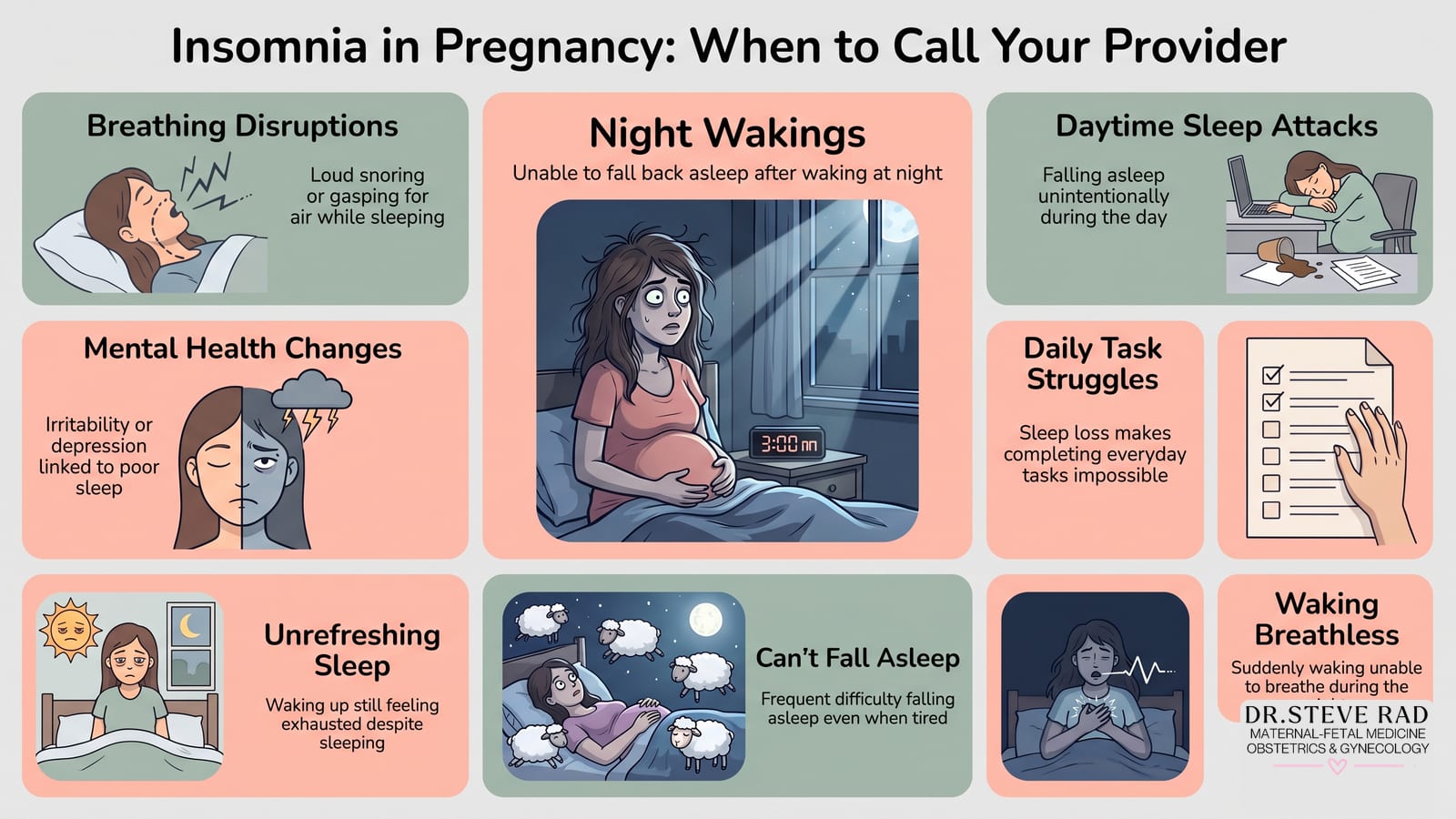
Not all insomnia in pregnant women is cause for alarm. However, if your insomnia is frequent or interfering with your daily life, let your provider know. You should also contact your healthcare provider if you notice any of the following sleep-related symptoms:
Night wakings that prevent you from returning to sleep
Loud snoring or gasping for air during sleep
Mental health changes such as irritability or depression
Falling asleep unintentionally during the day
Inability to complete your daily routine or tasks
Not feeling rested when you rise in the morning
Frequent difficulty falling asleep despite feeling tired
Waking up unable to breathe
Treatment options for pregnancy insomnia
For those dealing with pregnancy insomnia, lying awake night after night while your household sleeps can feel isolating and exhausting. The good news is that effective, pregnancy-safe treatments exist, and you don’t have to simply endure it. Treatment typically starts with behavioral strategies and escalates only when needed.
Sleep hygiene: the essential foundation
The National Sleep Foundation advises focusing on sleep hygiene as the first proactive step. Good sleep hygiene during pregnancy includes:
Keeping a consistent bedtime and regular wake-up time, even on weekends
Sleeping on your left side, which improves circulation to the baby and reduces pressure on major blood vessels
Using a pregnancy pillow to support your belly, hips, and back
Keeping your bedroom cool, dark, and quiet
Reducing screen time for at least an hour before bed, as blue light suppresses melatonin production
Avoiding large meals, caffeine, and fluids close to bedtime to reduce nighttime bathroom trips and GERD flares
Getting regular, moderate exercise such as prenatal yoga or walking, which has been shown to improve sleep quality in pregnancy
Practicing relaxation techniques such as deep breathing, progressive muscle relaxation, or guided meditation before bed
Cognitive behavioral therapy for insomnia (CBT-I)
When sleep hygiene alone isn’t enough, cognitive behavioral therapy for insomnia, known as CBT-I, is the first-line recommended treatment for chronic insomnia, including during pregnancy. Unlike medication, CBT-I addresses the thoughts and behaviors that perpetuate sleeplessness, making it both effective and safe for pregnant patients.
CBT-I typically involves several components delivered over four to eight sessions with a trained therapist:
Stimulus control: Retraining your brain to associate the bed with sleep rather than wakefulness. This means getting out of bed if you can’t sleep after 20 minutes and returning only when drowsy.
Sleep restriction therapy: Temporarily limiting time in bed to consolidate sleep, then gradually extending it as sleep efficiency improves. This sounds counterintuitive but is one of the most effective CBT-I techniques.
Cognitive restructuring: Identifying and challenging unhelpful beliefs about sleep, such as “I’ll never function tomorrow if I don’t sleep eight hours tonight.”
Relaxation training: Structured techniques including progressive muscle relaxation, diaphragmatic breathing, and mindfulness to reduce the physiological arousal that keeps you awake.
CBT-I is available through licensed therapists, and digital CBT-I programs have also shown strong evidence. Ask Dr. Rad’s team for a referral if you feel this approach would help you.
Medication safety during pregnancy
We know that when you’re exhausted, the temptation to reach for a sleep aid is real. However, medication safety during pregnancy is a nuanced topic, and we want you to have clear, honest information.
Many commonly used sleep medications, including prescription sedative-hypnotics and certain antihistamines like diphenhydramine (the active ingredient in many OTC sleep aids), are generally approached with caution during pregnancy. The concern is not always that they are definitively harmful, but that safety data in pregnant populations is limited and the risk-benefit calculation changes when a developing baby is involved.
Melatonin is a supplement many people assume is automatically safe because it is “natural.” However, melatonin’s safety profile in pregnancy has not been well established, and some research suggests it may influence fetal development. We recommend calling our office before starting melatonin or any over-the-counter sleep aid, rather than assuming it is safe.
In situations where insomnia is severe, is driven by an underlying anxiety or mood disorder, or is not responding to behavioral treatment, a provider may carefully weigh the option of a prescription medication. This decision should always be made collaboratively, with full awareness of the risks and benefits for your specific situation. Dr. Rad’s team is experienced in navigating exactly these conversations and can guide you toward the safest, most effective path for you and your baby.
Will insomnia improve after pregnancy?
This is a question many exhausted parents-to-be ask, and it deserves a direct answer. For most people, the hormonal and physical drivers of pregnancy insomnia do resolve after delivery. However, the postpartum period brings its own sleep challenges, including newborn feeding schedules, post-birth hormonal shifts, and the emotional adjustment to parenthood.
Postpartum insomnia, particularly when it persists beyond the newborn phase or is accompanied by mood changes, can be an early sign of postpartum depression or another perinatal mood disorder. If sleep doesn’t improve in the weeks after delivery, or if you feel persistently low, anxious, or disconnected, please reach out. Early intervention makes a significant difference, and Dr. Rad’s team is here for you well beyond your due date. That is the Dr. Rad difference.
Have more questions about pregnancy insomnia? Talk to Dr. Rad
Perinatologist Dr. Rad and his world-class team at Los Angeles Fetal and Maternal Care Center understand your pregnancy before, during, and after birth.
A master of obstetrics, gynecology, maternal-fetal medicine (perinatology), and high-risk pregnancies, Dr. Rad and his team provide compassionate care to help you understand your pregnancy. We treat all patients as VIPs, ensuring you feel cared for and supported at every step. Our team is available 24/7 to answer your questions and provide the emotional support needed to safely navigate your pregnancy.
Dr. Rad is currently accepting new patients. Call us at (844) 473-6100 or schedule your consultation online.
We are conveniently located for patients throughout Southern California and the Los Angeles area at locations in or near Beverly Hills, Santa Monica, West Los Angeles, West Hollywood, Culver City, Hollywood, Venice, Marina del Rey, Malibu, Manhattan Beach, Newport Beach, Irvine, and Downtown Los Angeles. We also offer in-home prenatal care and a fly-in program for out-of-town and international patients. Dr. Rad even travels to patients who need him throughout the U.S. and around the world.
If you can’t make it to Dr. Rad, he also offers virtual consultations worldwide.
Call (844) 473-6100 or click here to schedule online